
What I keep coming back to with the Bell Rock lighthouse is not the tower itself but the clock Robert Stevenson was building against, and it was not a clock he controlled.
Bell Rock is a reef about 11 miles off Arbroath, on Scotland's east coast. For most of the day it does not exist. The sea covers it. Twice a day, for a window the tide decides and the weather can cancel without notice, it breaks the surface and a crew can stand on it. That window, not a drawing or a deadline, set the pace of the whole job between 1807 and 1810.
According to the National Library of Scotland's account of the build, work in the early seasons was limited to about two hours at each low tide, and only in the summer months. Stevenson's own published account of the project records the arithmetic of this in his site diary: some days gave him "seven hours' work upon the Rock in one ebb-tide", others as little as a few, and even as the courses rose his masons were, in his words, working knee-deep in water during the neap tides. The 1808 season, by several accounts including the project's own history site, produced only around 80 hours of building time across the whole summer. Eighty hours, for a season's work on a lighthouse.
The reason the rock needed a light at all was the wreck of HMS York, a 64-gun warship that struck Bell Rock and went down with all hands after leaving Woolwich at the end of 1803. The loss, and the outcry that followed it, is what got the Bell Rock scheme through Parliament in 1806 with John Rennie consulted on the design and Stevenson appointed to build it.
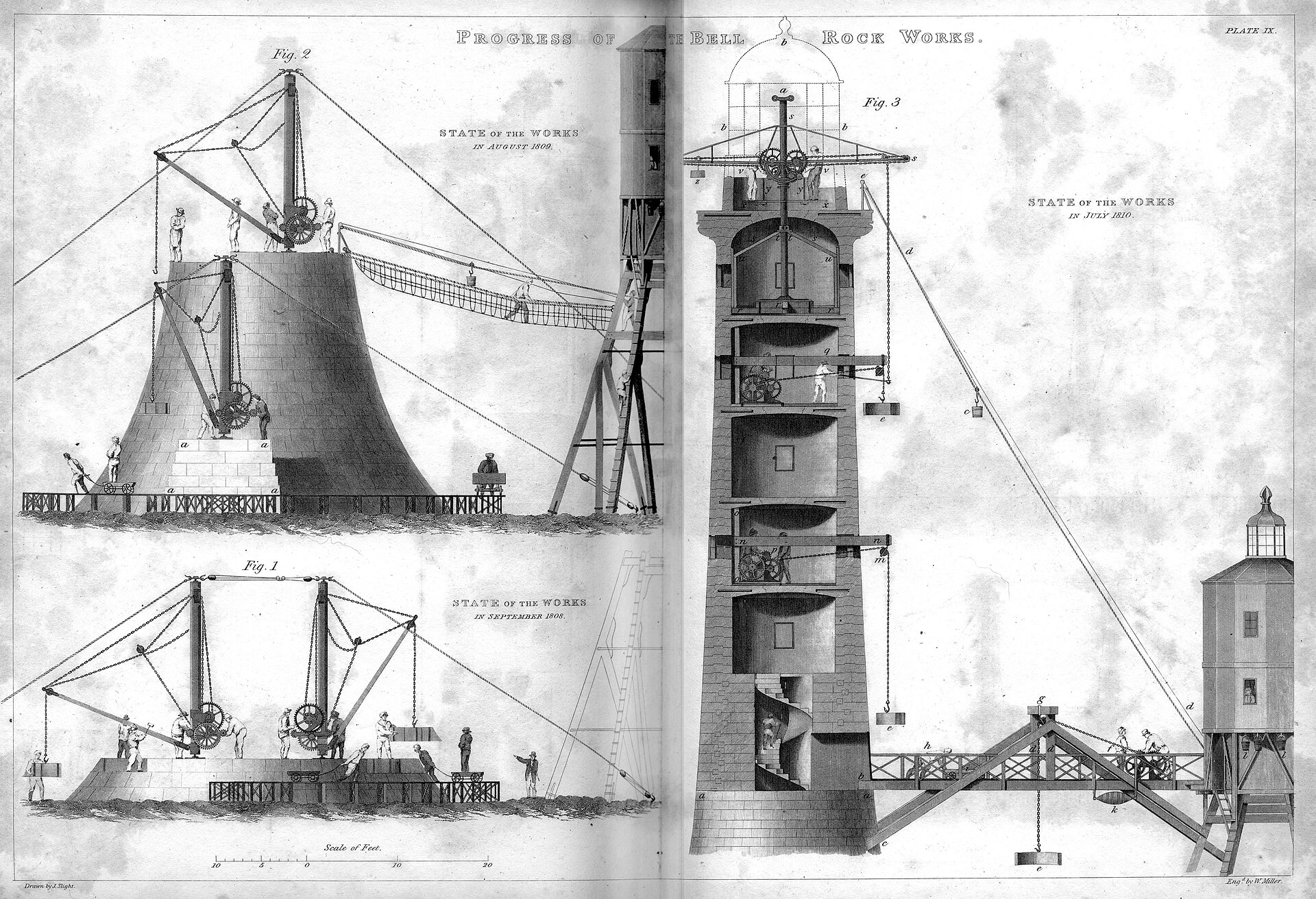
Stevenson's answer to the tide was to stop treating the rock as a site and start treating it as a target you supplied from elsewhere. The crew lived first on a converted fishing boat moored nearby and renamed the Pharos, then, once enough stone was in place, in a beacon house raised on wooden legs above the rock and reached by a timber bridge, so they could still get to the work when the water was over the foundations. Every stone, close to 2,500 to 2,800 blocks of granite and sandstone by the project's own reckoning, had to be cut and dressed somewhere else and landed in the gaps the tide allowed. One horse, recorded in Stevenson's account simply as Bassey, is reckoned to have hauled upwards of 2,000 tons of material to the quay over the life of the job, some of it making the same journey more than once.
What made the stone stay put once it arrived was dovetailing: each granite block cut so a wedge shape on one stone locked into a matching recess on the next, the courses pinned through with oak trenails driven into bored holes and tightened with wedges. No mortar was going to survive being washed twice a day before it set, so the structure had to hold together mechanically, course by course, from the first stone up. It has held. The tower, about 35 metres tall, was finished to a standard that has needed no structural alteration in two centuries, and it was still showing a light to ships when it was automated in 1988.
The project overran, Stevenson's £42,000 estimate for Bell Rock ending closer to £61,000 once the lighthouse was finished and lit on 1 February 1811, by most tellings about fifty per cent over. I find that oddly comforting rather than damning. Here was a programme where the critical path was not drawn by an engineer at all. It was set by the moon, revised by the weather, and never once asked to explain the delay.
What stays with me is the ordinariness of the constraint once you sit with it. Every job has something outside the contract that decides how fast you can actually go. Stevenson's happened to be visible twice a day and gone twice a day, which is probably the only reason anyone wrote it down carefully enough for me to read, two hundred years later, how many hours he actually got.
*Image: Progress of the Bell Rock Works, engraved by William Miller after J. Slight for Stevenson's Account of the Bell Rock Light-House, 1824, public domain, via Wikimedia Commons.*
Comments