
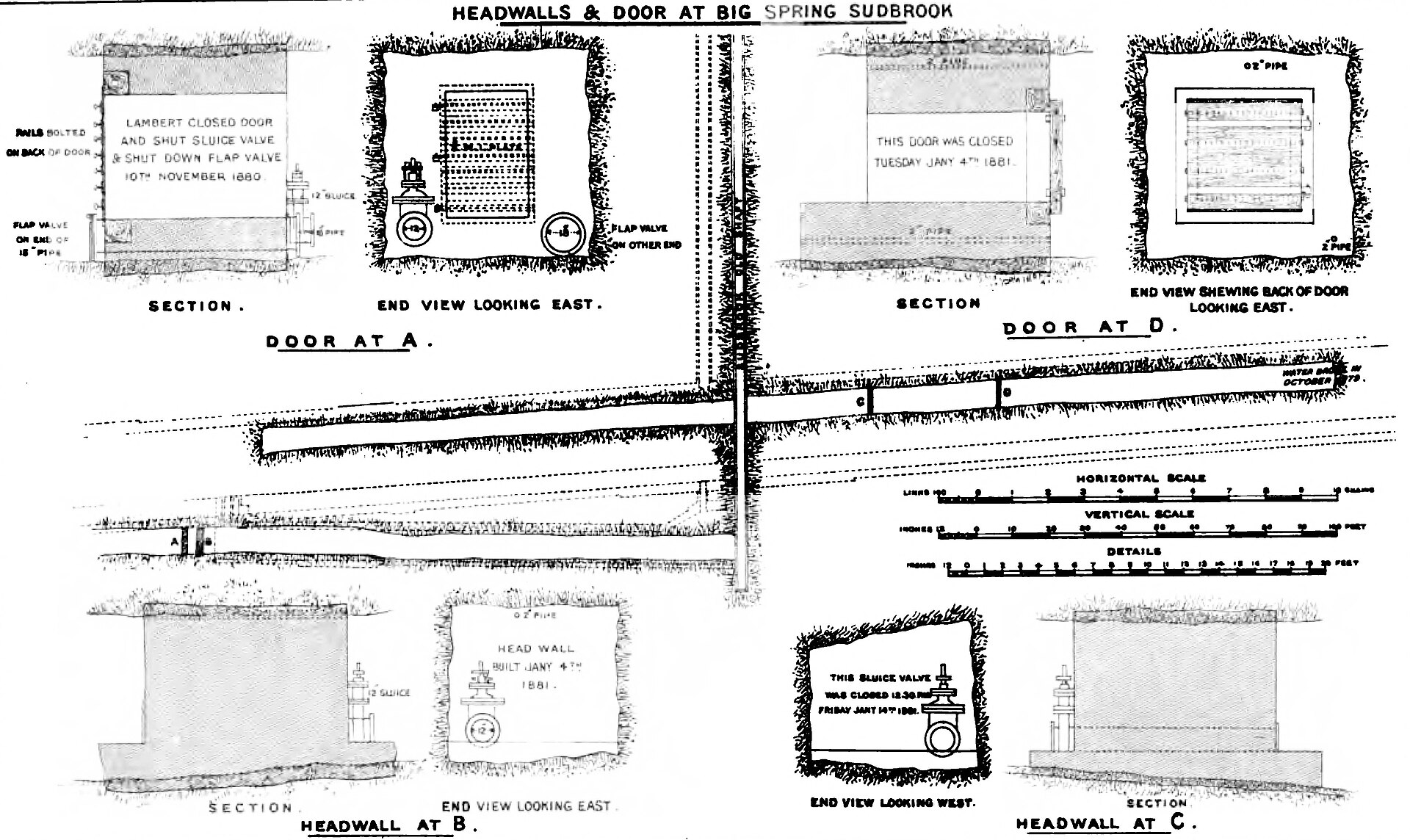
Picture a man in total darkness, 1,000 feet up a flooded tunnel heading, breathing from a knapsack of his own compressed oxygen, feeling his way over submerged wagons because there is nothing else to feel. That is Alexander Lambert on the night of 10 November 1880, and what he is trying to do, with his bare hands, is shut a door.
The door matters because of what is behind it. The Severn Tunnel was being driven by the Great Western Railway to carry trains under the river between Gloucestershire and Monmouthshire, instead of around it. Work had started in 1873 under the contractor Thomas Walker, with Sir John Hawkshaw as chief engineer, and it was going reasonably well until October 1879, when the headings broke into a fissure the workers came to call the Great Spring. It was not river water. It was fresh water draining off the Welsh hills, and once it broke through there was no quick way to stop it; by some accounts it took the best part of two years before the workings were properly dry again.
What I find genuinely interesting here is the dead end the Victorians hit before Lambert even got involved. Conventional divers, in full hard hat and hose, tried repeatedly to reach the stop valve and seal the breach. They kept failing, not through lack of nerve but because their air hoses snagged on timber and wreckage in the dark, and the current in the flooded heading was strong enough to drag a man and his line into trouble. A tethered diver cannot work in a space like that. The job needed someone free of the surface altogether.
That is where Henry Fleuss comes in. He had patented a self-contained breathing apparatus in 1878, a rubber mask and bag fed by compressed oxygen, with the carbon dioxide scrubbed out by rope yarn soaked in caustic potash, good for a few hours underwater with no hose to anyone. Fleuss brought it to the tunnel himself in November 1880 and tried the dive, but by his own account he hadn't the diving experience or the nerve to go far enough up the heading in pitch darkness. So he trained Lambert, the project's lead diver, to use it instead.
Lambert's first attempt, on 8 November, got him to the door. He pulled up one of two rails that had been laid across the sill and were jamming it shut, then, by his own telling, lost his nerve at the strangeness of the apparatus and turned back without finishing the job. Two days later he went in again, reached the same door, pulled the second rail clear, dropped the valve and sealed it. He was underwater, alone, for about an hour and twenty minutes. Walker's own account of the tunnel's construction records the moment almost matter of factly, which somehow makes it more startling: a man solving a jammed rail problem by touch, 300 metres into a drowned tunnel, using equipment that had barely been tested.
It worked. The Great Spring was sealed off by January 1881, the headings met in 1885, and the first passenger train ran through on 1 December 1886, through what was then the longest underwater tunnel in the world at just over four miles, a record it held for about a century. Lambert's dive is now generally reckoned the first operational use of a self-contained diving apparatus anywhere, which makes the Severn Tunnel an odd kind of landmark: a railway project that, in passing, helped invent the aqualung.
The spring was never actually beaten, only agreed with. It still rises exactly as it did in 1879, and the pumping station at Sudbrook still pumps it out, around ten million gallons a day according to Network Rail, every day, with nobody really noticing, while trains run through dry above it. Lambert shut one door in the dark. Somebody has been quietly reopening the tap ever since.
*Image: Headwalls and door at the Big Spring, plate from Thomas A. Walker's The Severn Tunnel, Its Construction and Difficulties, 1888, public domain, via Wikimedia Commons.*
Comments