
In 1969 an engineer called Charles Draper built a working model of a flood gate on a table at his parents' house in Wood Green, London. He worked for the consulting engineers Rendel, Palmer and Tritton, who had spent years failing to solve one problem: how do you put a barrier across a working tidal river wide enough for ocean going ships, and still close it completely when a surge comes up from the North Sea.
Every design tried so far failed one half of that test. A gate that stood permanently above the water blocked shipping and was, by most accounts, ugly. A gate that lay flat on the riverbed could lift clear for boats but would not seal against a storm tide. Draper's model did both, and the idea for it, as the story is usually told, came to him from the tap on his own gas cooker: a curved segment rotating inside a housing, open one way and shut the other.
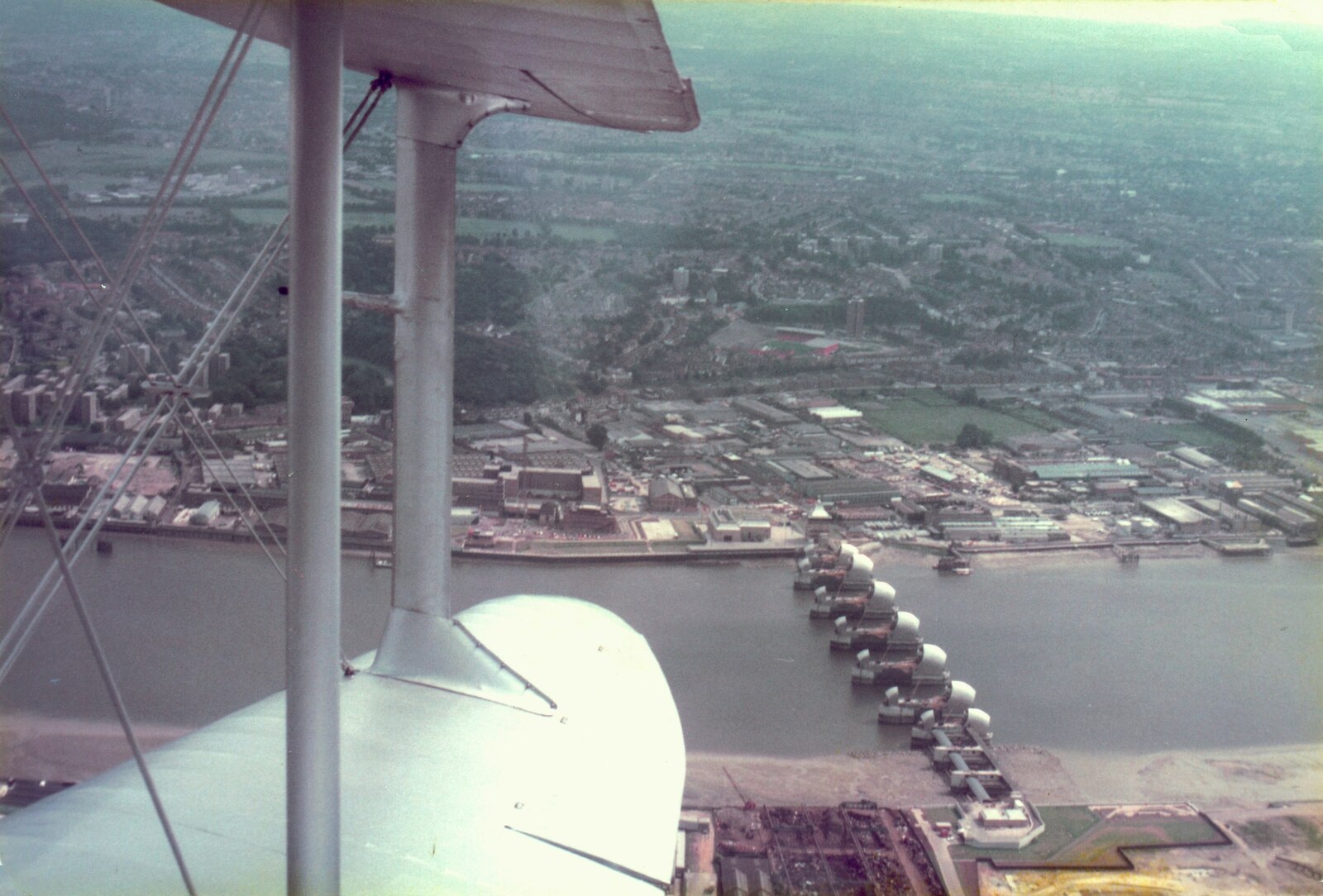
Scaled up by a factor of thousands, that is exactly what the Thames Barrier's main gates still do. Each rising sector gate is a hollow steel shell, shaped in cross section like a capital D, resting in a concrete sill on the riverbed when open so that shipping passes straight over the top. To close, it rotates up on trunnions at each end until the curved face stands across the flow. The four largest of these gates are 20.1 metres high, weigh 3,700 tonnes each, and are built from steel up to 40 millimetres thick. Four smaller falling radial gates, a simpler lift version of the same principle, cover the narrower channels between the piers, with two more rising sector gates completing the ten.
Rendel, Palmer and Tritton took Draper's kitchen table idea to the Hydraulics Research Station at Wallingford, where it was tested at model scale in a flume before the government would commit real money to it. As a quantity surveyor you learn to distrust any number that hasn't been tested against something trying to break it, and a gas tap turned into a full barrier design is as far as I have seen that principle stretched.
Parliament passed the Thames Barrier and Flood Prevention Act in 1972. Work on the river started in 1974, a consortium of Costain, Hollandsche Beton Maatschappij and Tarmac building the piers and sills while Davy McKee and Cleveland Bridge built the gates and machinery. The first gate was tested in full on 31 October 1982, and the Queen opened the barrier officially on 8 May 1984. The barrier itself cost around 461 million pounds of the day, with the wider river defences either side taking the whole scheme to roughly 535 million, a sum that would be several times larger now.
It was designed, by most tellings, to close occasionally. What actually happened is on record with the Environment Agency: four closures through the 1980s, thirty five through the 1990s, and well over a hundred since 2000, with winter 2013 to 2014 alone accounting for fifty closures in thirteen weeks. The Agency now treats fifty closures in a single year as the point at which the barrier starts to come under real strain. The total passed two hundred some years ago and keeps climbing.
I like picturing Draper at that kitchen table, turning a gas tap back and forth to work out how to rotate a gate nobody else had managed to design, with no way of knowing it would end up holding back the sea from London more than two hundred times and counting, on a schedule nobody in 1969 expected it to keep.
*Image: The Thames Barrier seen from a Dragon Rapide, Stefan Czapski, 1986, CC BY-SA 2.0, via Wikimedia Commons.*
Comments