
In May this year, a 500 tonne steel vessel just over thirteen metres long was pushed sideways through an opening in the wall of a reactor building at Hinkley Point C, turned upright by a crane working inside, and lowered onto a support ring with about 40mm of clearance on each side. New Civil Engineer reported the gap as 40mm either way, and the figure is repeated in other coverage of the lift. That is not much more than the width of your fist. The vessel was a reactor pressure vessel, the steel container the nuclear reaction itself sits inside, and the whole operation took the best part of two days.
What got the vessel to the building in the first place, and what has done most of the heavy lifting at Hinkley Point C since 2019, is a crane called Big Carl.
A crane with one client
Big Carl's proper name is the Sarens SGC-250. Sarens, the Belgian heavy lift firm that built it, named it after Carl Sarens, the company's director of technical solutions. In its tallest configuration it stands 250 metres, by EDF's own figures taller than the tallest tower at Canary Wharf, and it can lift 5,000 tonnes at a 40 metre radius, which EDF describes as the equivalent of 32 single storey houses in one go. It moves on 96 wheels, is held down by 52 counterweight containers weighing 100 tonnes each, and needs 12 engines just to shift itself between lift positions.
Hinkley Point C was its first assignment. It arrived from Sarens' base in Antwerp in 2019, shipped in 280 separate loads through Bristol Port's Avonmouth Docks, and as far as the public record shows it has not worked anywhere else since. A crane that size does not get built speculatively. It got built because one nuclear power station needed it.
What the scale is actually for
In December 2023, Big Carl lifted the dome onto the first reactor building: a steel cap weighing 245 tonnes, 47 metres across, wider than the dome of St Paul's Cathedral, welded together from 38 prefabricated panels along 900 metres of weld, by EDF's account of the lift. That is the kind of job a crane this size exists for. The dome is enormous and the fit does not need to be exact, so raw lifting capacity does almost all the work.
The reactor vessel lift in May was the opposite kind of problem. Big Carl's job was to get the vessel into the building and roughly into position. The last few centimetres, onto a ring with millimetres rather than metres to spare, were handed to a smaller crane working inside the building itself. The project team called this an improvement on how the first unit's vessel went in, built specifically to save time and cost on the second.
What I like about Big Carl is that contradiction. It is the biggest land based crane in the world, capable of moving the equivalent of a terrace of houses in a single lift, and its most publicised recent job depended on getting a steel tube to within a few millimetres of a fixed ring. The scale is the headline. The precision is the actual engineering. Years spent checking contracts rather than steelwork taught me that the two are rarely the same skill, and it is rare to see a single machine asked to do both in the same afternoon.
Nobody has said publicly where Big Carl goes once Hinkley Point C is finished. EDF has said the lessons from building two reactors there will carry over to Sizewell C in Suffolk, which is designed to be close to a repeat of the same station. Whether the crane itself makes that journey, gets dismantled on site, or waits for the next client willing to commission something this large for one job, is not something I could find an answer to. For a machine this specific, built once and named after a person rather than a model number, that feels like the right kind of question to end on.
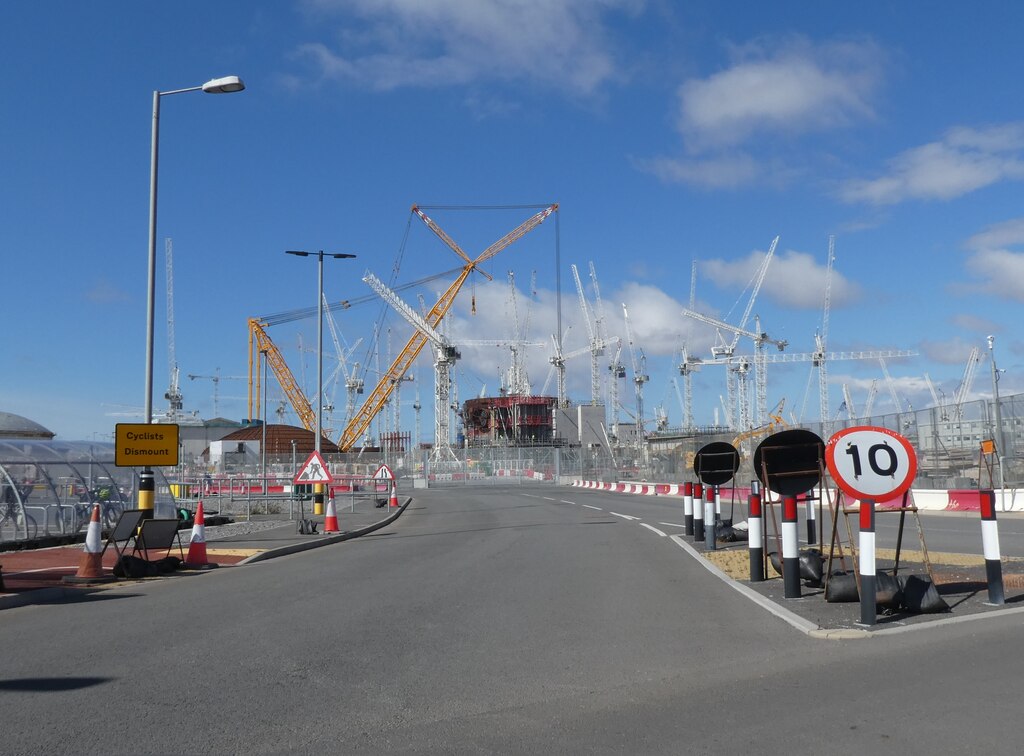
*Image: A forest of cranes at the Hinkley Point C construction site, Roger Cornfoot, 2022, CC BY-SA 2.0, via Wikimedia Commons.*
Comments