
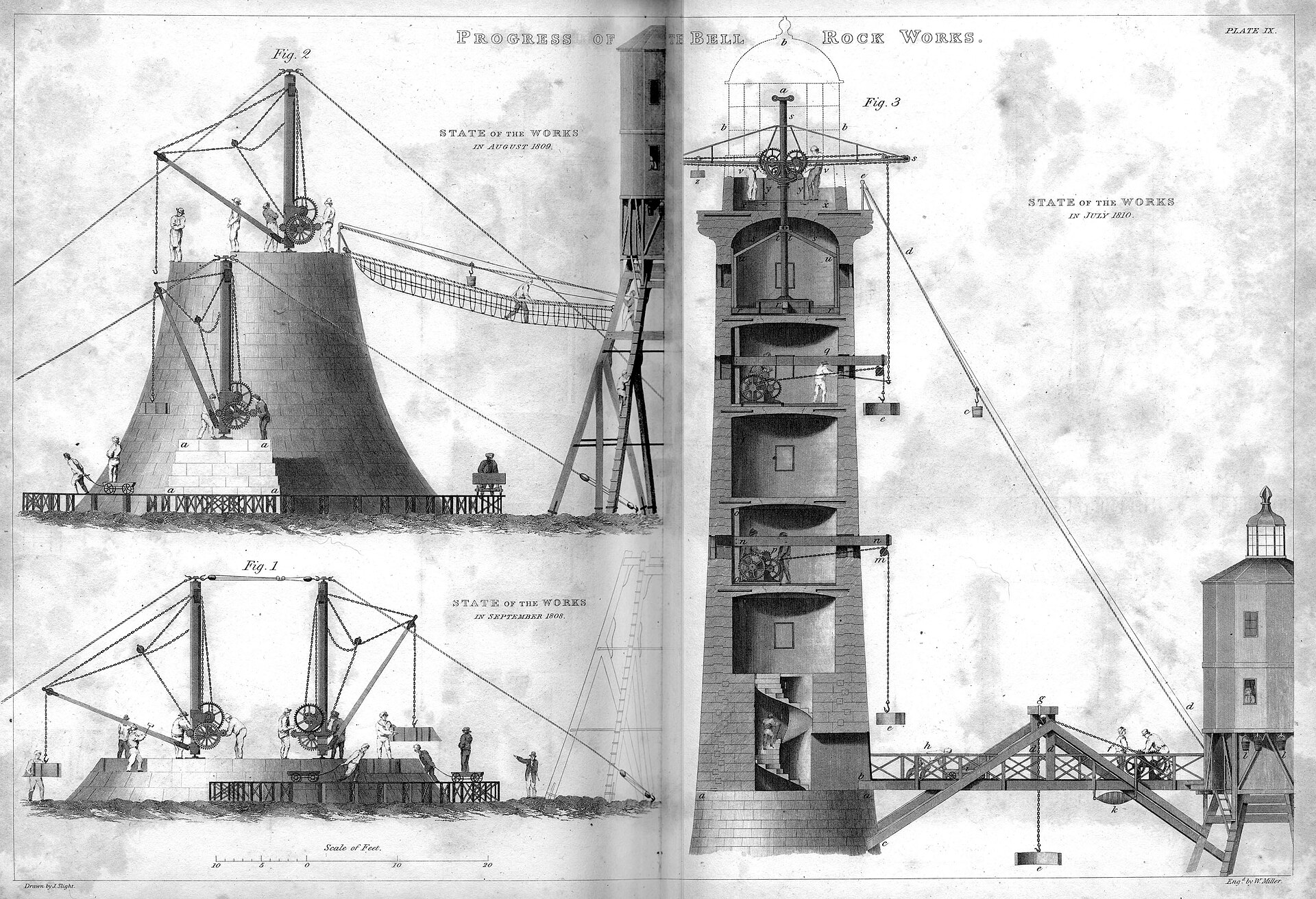
What I keep coming back to with the Bell Rock lighthouse is not the tower but the clock Robert Stevenson was building against, and it was not a clock he controlled. Two hundred years on, 130 kilometres off the Yorkshire coast, a jack-up ship called Voltaire has stood on her legs in the North Sea since 2023 lifting wind turbines, and the clock she works to is not one her owners control either. The problem underneath both jobs is the same: the sea lets you work when it chooses, and the job has to be shaped around that.
Two hours a tide
Bell Rock is a reef 11 or 12 miles out from the Angus coast, depending on who is measuring, east of the mouth of the Tay. For most of the day it does not exist. The Northern Lighthouse Board puts the water over it at high tide at some 16 feet; Roland Paxton, writing for the East Lothian Antiquarians, says 14. Either way, twice a day the rock breaks the surface, and for a while a crew can stand on it.
That window set the pace of the whole job between 1807 and 1810. The National Library of Scotland's account of the build says that until the foundations and lower courses were in, work was possible "only for two hours at each low tide", and only in the summer months. Wikipedia's account reckons the whole second season, 1808, produced roughly 80 hours of building work on the rock. I could not find a second source for that number, so take it as an order of magnitude. Eighty hours, give or take, for a summer's work on a lighthouse.
The reason there had to be a lighthouse at all was the wreck of HMS York in 1804, lost on the reef with all her crew, which Grace's Guide and George Hay's 1876 history of Arbroath both record as the loss that shamed Parliament into the Act of 1806. Paxton dates the Act to 21 July that year, carried with John Rennie's support. Rennie was appointed chief engineer. Stevenson, the younger and less experienced man, built it.
Stevenson's answer to the tide was to stop treating the rock as a site and start treating it as a target supplied from elsewhere. In 1807 the men lived aboard a captured Prussian fishing vessel of 82 tons, fitted out as a floating light with a copper lantern on each of her three masts and moored near the reef, where a nineteenth-century account digitised by the National Library says she rolled like a tub even in fair weather. Then came the beacon: a timber tower on legs raised above the sea and joined to the work by a bridge, converted, the NLS says, into a barrack so the men could reach the work while the water still covered the foundations. Wikipedia puts its capacity at fifteen. Paxton's point about it is the sharper one: the beacon barrack did away with the trip to and from ships anchored some distance off, and gave back to the window the minutes the boats had been eating.
Every stone was cut somewhere else. The granite came from Rubislaw near Aberdeen and the sandstone from Mylnefield near Dundee, on which the NLS and the Lighthouse Board agree, dressed in a yard at Arbroath and shipped out to be landed in the gaps the tide allowed, then run across the reef on a cast iron railway to cranes at the tower. Wikipedia counts about 2,500 stones; the NLS says 2,800. Both say that at the Arbroath end a single horse, Bassey, hauled all of it.
What made the stone stay put once it arrived was dovetailing. Each block was cut so that a wedge on one stone locked into a recess on the next, and each course was pinned to the one below with oak trenails, pegs driven into bored holes and tightened with wedges. No mortar was going to survive being drowned twice a day before it set, so the tower had to hold itself together mechanically, course by course, from the first stone up. Paxton records that it was Rennie who insisted on the dovetailing, and that an engineer looking back later thought Stevenson's own early design, which was not dovetailed, would not have left one stone standing. We will never know. What stands is a tower of about 35 metres, solid masonry for its first 30 feet, lit on 1 February 1811 and demanned, the Lighthouse Board says, on 26 October 1988.
The cost is the part I find oddly comforting. Stevenson's estimate was £42,000, a figure Wikipedia and the Odyssey Traveller history both give; Paxton and Hay both put the finished account at £61,331 9s 2d. Call it fifty per cent over. Hay records that only two lives were lost in the building, which Wikipedia's account names as a young man drowned in 1808 and a labourer, Charles Henderson, swept away in a storm in 1810. Here was a programme whose critical path was drawn by the moon, revised by the weather, and never asked to explain itself.
The window moves offshore
The problem has not gone away. It has moved 130 kilometres out to sea and grown by a factor I find hard to picture.
Dogger Bank Wind Farm sits on the sandbank that was once the land bridge to Europe. By the project's own figures the first two phases, A and B, lie around 131 kilometres off the Yorkshire coast at their nearest point, in water that Jan De Nul's contract announcement put at 20 to 35 metres deep. Three phases of 1.2 gigawatts each, 3.6 in all, 277 turbines: 95 at A, 95 at B and 87 at C. Equinor, which owns it with SSE Renewables and Vårgrønn, put the capital cost of A and B at around £3 billion each when the finance closed in November 2020. SSE builds it; Equinor will run it.
Nobody stands on the Dogger Bank at low tide; there is none in the sense that matters. What there is instead is a forecast, and a vessel that can only lift when the forecast says she can.
The vessel is Voltaire. Jan De Nul's own specification sheet gives her four legs of 130 metres, a crane rated at 3,200 tonnes, 110 single cabins and a build year of 2022; Baird Maritime's review gives the crane as over 3,000 tonnes and the accommodation as 100. She arrives over a foundation, lowers the legs to the seabed and jacks her hull clear of the waves, which is Stevenson's beacon house again, two centuries on, with retractable legs and a barrack for a hundred. Then she lifts a turbine whose blades are 107 metres long on a rotor 220 metres across, by Equinor's and GE's own figures, to a tip height GE gives as 248 metres. The project's weekly notice of operations, published for other sea users, says the work is "continuous, 24 hours a day" for the duration. The first of the 95 turbines at A went in on 29 August 2023, and the first power reached the grid on 10 October.
Everything is still cut somewhere else. The nacelles, tower sections and blades come to Able Seaton Port at Hartlepool for pre-assembly, Equinor's announcement of the turbine order says, and go out to sea in loads. The monopiles went out on a different ship altogether, Seaway7's heavy-lift vessel Seaway Strashnov, which drove all 277 of them and finished the last at C in September 2025; the transition pieces that sit on top went in from the Seaway Alfa Lift, the last in late November 2025. Equinor's release that month put the foundation work at three years and more than a thousand lifts.
What a lost window costs now
Here is where the two jobs part company.
Stevenson's window was visible. It arrived twice a day, its length was in the almanac, and when it closed the men got into the boats. Voltaire's window is a number: a significant wave height and a wind speed above which the crane does not lift and the legs do not jack. The limits for Dogger Bank are not published, but JBA Consulting's ForeCoast planning material, which is illustrative rather than project data, models a jack-up fleet at a 2.5 metre wave threshold and a heavy-lift vessel at 1.6 metres, and finds, unsurprisingly, that winter campaigns run long. Whether a window exists on Tuesday depends on a forecast read on Sunday, and on how far the crew trusts it.
The cost of being wrong is what has changed most. Clarksons Securities, quoted by Riviera Maritime Media, modelled installation vessel day rates at 225,000 US dollars a day for 2023 and 2024 and a jump to 300,000 in 2025; recent charters in the same article run at about 300,000 dollars and 375,000 euros a day. Spinergie, an analytics firm, told the WindEurope conference in 2025 that across 28 European projects from 2020 to 2024 the median was 0.89 days of downtime per turbine installed. Multiply a day's hire by the days the North Sea takes back and you have a budget line Stevenson never carried.
And the sea did take days back. On 8 February 2024 SSE told the market that "turbine installation on Dogger Bank A has been affected by challenging weather conditions", with vessel availability and supply chain delays further impacting progress, and that after "notification of further vessel unavailability over the coming weeks" full operations might not come until 2025. The same statement counted ten named storms that winter. By late March 2024 Voltaire had installed twelve turbines and gone to Vlissingen for scheduled maintenance; she was back in May. In October 2024 SSE moved completion of A to the second half of 2025. The weekly notice for 16 February 2026 recorded the 95th and last turbine at A in place, two and a half years after the first, and SSE's trading update that month said commissioning should finish later in 2026.
Not all of it was weather. In May 2024 a blade failed on an installed turbine, which GE Vernova put down to an installation error, and on 22 August 2024 a second blade failed; GE's analysis, widely reported at the time, found the turbine had been left with its rotor locked during commissioning and had met a storm in that state. Nobody was hurt. Stevenson had a crane collapse in 1809 and a man drowned in 1808. Dogger Bank has its blades, its reviews, and a safety record the Georgians would not have believed possible.
Then Voltaire went to B. Offshore Wind reported the first turbine there in early March 2026, 49 of 95 by the notice in early October, and a second jack-up, Seaway Ventus, due on site on 9 October to run alongside her until the phase finishes around the second quarter of 2027. Turbines at C begin the year after. Two ships standing on legs in the North Sea, each lifting when the forecast says so, with a guard vessel and a marine coordination centre, the notice says, on watch around the clock.
Side by side
Strip the two jobs of their dates and much is the same. A rock, or a bank, you cannot live on, so you live beside it in something on legs. Everything cut and dressed ashore and carried out in loads. A supply chain, a horse or a port, feeding a workface that is only open some of the time. A crew that goes out for the season, because the season is when the sea lets you. A programme that slips in public, and an owner who has to explain, in Stevenson's case to Rennie by letter, in SSE's to a stock exchange by trading statement, that the weather did it.
What is different is the margin. Stevenson's cost overran by half on a job whose materials were stone, oak and a horse, and whose labour was paid whether the tide came or not. Dogger Bank's margins are made of vessel day rates, charter windows reserved years ahead, a turbine supplier's blade problem and a power price fixed before the first pile was driven. The Georgian programme absorbed its lost hours in a ledger nobody audited. The modern one reports them quarterly.
And something is different about the window itself. Stevenson could see his. He wrote down the hours he got, which is why I can read them. Voltaire's window is a forecast, and a forecast is a thing you argue with. I do not know, and I suspect the people on board do not always know, whether a lost day was the sea's or theirs.
What stays with me is the picture of the two barracks on legs, 1808 and 2026, one timber and one steel, each put there for the same reason: so that when the sea opened, for two hours or for two days, the people who needed to be at the work were already there.
*Image: Progress of the Bell Rock Works, engraved by William Miller after J. Slight for Stevenson's Account of the Bell Rock Light-House, 1824, public domain, via Wikimedia Commons.*
Comments