
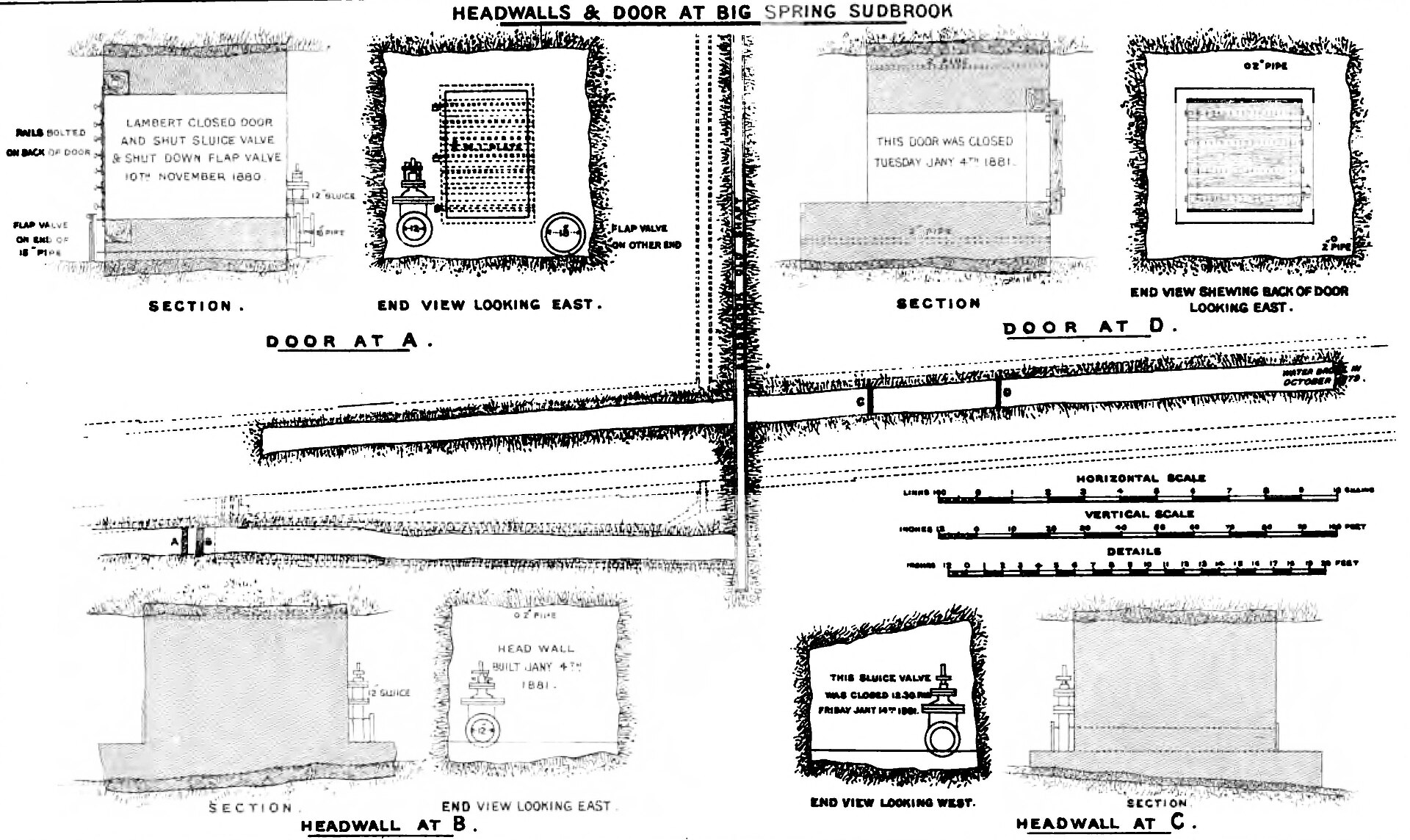
Picture a man in total darkness, roughly 1,000 feet up a flooded tunnel heading, breathing from a knapsack of compressed oxygen, feeling his way over drowned skips and timber because there is nothing else to feel. That is Alexander Lambert on the night of 10 November 1880, and what he is trying to do with his bare hands is shut a door.
The door matters because of what is behind it. The Great Western Railway had been driving the Severn Tunnel since March 1873, with Sir John Hawkshaw as engineer, to take trains under the river between Gloucestershire and Monmouthshire rather than round it. In October 1879, with the two headings 130 yards apart by Grace's Guide's account, the miners broke into a fissure. The water was fresh, draining off the Welsh hills, not the river at all, and within a day the workings had filled to the level of the Severn outside. The men called it the Great Spring, and the name stuck.
What I find most interesting is the dead end they reached before Lambert even got into the water. A watertight door had been built into a headwall in the heading, and if someone could get to it, pull clear the two rails laid across its sill, close it and screw down a 12 inch sluice valve beyond, the spring would be shut off from the rest of the workings and the pumps could win. Lambert, chief diver for Siebe Gorman, tried it first in the standard dress, hard helmet and air hose. He got about 900 feet, dragging the hose through the dark over wreckage, and the drag of the line beat him.
So the problem had become a diving problem, and a new piece of kit happened to exist. Henry Fleuss had patented a self contained breathing set in 1878: a rubber mask, a breathing bag, a tank of oxygen and, by the usual account, rope yarn soaked in caustic potash to scrub out the carbon dioxide, good for about three hours. Fleuss brought it to Sudbrook himself and went in, more than once by Walker's telling, and could not do it. He was an inventor, not a working diver, and the darkness and the mud were too much. So he taught Lambert the set instead.
Lambert's first go on 8 November got him to the door. He lifted one of the two rails, turned one valve, and came back without finishing. Two days later he went in again, cleared the second rail, shut the door and turned the sluice valve the number of turns he had been told. Divernet, which has retold the dive carefully, puts him underwater for about 80 minutes on that second trip. Then comes my favourite detail, which Thomas Walker, the contractor, records in his own book and the Bristol Exploration Club's account repeats: the sluice valve had a left hand thread. Lambert had turned it exactly as instructed and opened it. The foreman of the pumps walked up the heading on 7 December, once the water had dropped enough to walk, and found out why the level had come down so slowly.
It still worked. The spring was shut out on 4 January 1881, the headings met under the river on 26 September that year, and when the Great Spring broke in again in October 1883 Lambert was called back to deal with it a second time. The last brick went in during April 1885. Goods trains ran from January 1886 and the first passenger train on 1 December 1886, through 4 miles 624 yards of tunnel that, by Wikipedia's reckoning, stayed the longest underwater tunnel in the world until Japan's Seikan opened in 1987. Nobody died in the flood, which was luck as much as design.
The thing that matters for the rest of this piece is what they did with the water once the tunnel was finished, which is nothing clever at all. They lifted it. Coflein, the Welsh heritage record, says the pump house at Sudbrook had six Cornish beam engines to pump 20 million gallons a day from the Great Spring, and steam was only withdrawn in 1964. Network Rail's figure in 2011 was more than ten million gallons of spring water a day, roughly 50 million litres, the figure the local histories also give. In 2022 Network Rail replaced the fourteen pumps, each a tonne and a half, lifted out of a 60 metre shaft, as it does roughly every 30 years when their design life runs out. The Victorians never beat the spring. They agreed to pump it for ever, and so far everyone since has kept the agreement.
The same water, in chalk
Now move the problem about 100 miles east and 140 years on. The Chilterns are chalk, and chalk is an aquifer: a hill full of fresh water, fissured and jointed so the water moves through it, and tapped for public supply by Affinity Water. The River Misbourne runs through it, a chalk stream, one of about 260 left in the world by HS2's own count. Through this hill HS2 needed ten miles of twin bore tunnel, up to 80 metres down by HS2's figures, from the M25 to South Heath near Great Missenden.
The Severn had the water break in. The point of the Chiltern tunnel was that it must not break in at all, and must not break out either: no draining of the aquifer into the bore, no loss of the river into the tunnel, and nothing from the tunnel into the drinking water. Where Walker's answer to groundwater was a door and a pump, the answer from Align, the Bouygues, Sir Robert McAlpine and VolkerFitzpatrick joint venture building it, was never to let the water meet an open face.
The machines were two Herrenknecht variable density tunnel boring machines, Florence and Cecilia, 170 metres long, 10.26 metres across the cutterhead and about 2,000 tonnes each. The variable density design can run as an earth pressure balance machine or as a slurry machine and switch between them while keeping constant pressure on the face, which is the whole point. The chalk and the water in it are held back by pressure in the cutting chamber at every moment, and nobody has to go in behind the cutterhead to get at the ground. The spoil comes out as a slurry, chalk mixed with water, pumped back along the tunnel to the treatment plant at the South Portal just inside the M25.
Behind the cutterhead the machine builds the tunnel as it goes: 56,000 precast concrete segments per bore, placed into rings and grouted into place at the back of the shield, so there is never an unlined length of chalk standing open to the aquifer. HS2's summer 2024 newsletter gives the average as 16 metres a day and the best day, in October 2023, as 44 metres. A crew of 17 kept each machine running in shifts, with more than 100 people on the surface. Florence launched in May 2021, Cecilia in June, and between them they took out about three million cubic metres of chalk. At the plant the slurry was separated with a polymer chosen for Chilterns chalk, and HS2 says the chalk went into 127 hectares of new chalk grassland above the south portal.
Where it got through anyway
None of that made the water go away, and the record is candid about where it got through. The first of the five shafts, at Chalfont St Peter, is nearly 80 metres deep and was built as a diaphragm wall, sixteen panels dug under bentonite slurry and concreted one at a time. During that work in the autumn of 2020, between August and November by the Chilterns Conservation Board's account, bentonite got away into the fissured chalk. Align's reported figure, which surfaced through a Freedom of Information request in 2021, was 2,400 cubic metres; Engineering News-Record reported more than 1,500, and the campaigners' solicitors put it at about 2,500. The Conservation Board says it turned up in groundwater 500 metres from the site. HS2 said it regretted the loss, that monitoring showed no effect on the aquifer or supplies, and that the Environment Agency and the water company had raised no concerns.
The grout was the next worry. The Environment Agency consented to the tunnel in April 2021, and a group of local geologists and conservationists, Misbourne Environmental Protection, took it to the High Court, arguing that the machines would pass only 18 to 20 metres below a river bed sitting on fissured chalk, and that grout pumped into fast moving groundwater might not set and might wander. In November 2021 Mrs Justice Lieven refused permission, as Local Government Lawyer reported, on the basis that the risk of grout migration, with mitigation, was extremely low and the rest was professional judgement rather than law. The machines passed under the Misbourne for the first time at Chalfont St Giles in April 2022.
Then, on 13 May 2023, a hole about four metres across opened in a field at Little Missenden above the tunnel. HS2's own account, in a questions and answers document that July, is plainer than I expected. Cecilia had stopped for planned maintenance before the second river crossing, restarted, and then had to stop again for a mechanical fault, and that second stop happened to be next to a dissolution feature, a natural sinkhole filled with loose soil. When she moved off, the infill followed her. Align's surveyors found the settlement on their planned monitoring round and fenced it off. The tunnel there is about 20 metres down, the collapse was ten metres above the water table, and the boreholes around Little Missenden, checked daily, showed nothing out of the ordinary that weekend; the level in Shardeloes Lake did not move either.
What strikes me is how much of the modern method is simply refusing to stop. Both machines did their maintenance before the river and crossed it without a pause, by agreement with the Environment Agency and Affinity Water, because a pressurised face that stands still is a face that can lose ground. Every piece of work below the water table went to the regulator and the water company first for a written consent. Florence came out at the north portal in February 2024 and Cecilia in March, and the tunnel has not needed pumping since, because it was never allowed to fill.
Two answers to one spring
Put them side by side and the shared problem is obvious, and so are the costs on each side. Walker's men lost more than a year to the Great Spring, had the workings flood to river level twice, and sent a man alone into a drowned heading on a barely tested breathing set to turn a valve by feel. He got it wrong and nobody knew for a month. The Chilterns drive had no flood at all, but it did put somewhere around 2,000 cubic metres of clay into a drinking water aquifer before a single machine had launched, spent a year in court, and opened a hole in a field above it. Both sides had their guesses. The modern ones were written down, risk assessed and consented, and one of them was still wrong by a few metres of chalk.
What the Victorians could not do was hold the water back. They could only outpump it, and the price of that is permanent: six beam engines, then fourteen electric pumps replaced every generation, ten million gallons a day lifted up a 60 metre shaft for as long as there are trains. What Align could not do was work in the dark. Everything about the Chiltern method, the pressure, the lining, the grout, the boreholes read every morning, exists because the water was never going to be allowed in and dealt with afterwards. The quantity surveyor in me notices that the Chilterns bill for water is mostly paper, assessments and consents and monitoring rounds, while Sudbrook's is electricity, every day, with no final account.
I keep coming back to the valve. Lambert, alone, roughly 1,000 feet into the black, counting turns on a wheel he could not see, with the thread running the wrong way. Florence, 170 metres long, holding a column of chalk and water in balance by numbers on a screen, and a hole opening in a field anyway because the hill had something the boreholes had not found. The spring at Sudbrook still rises every day at the rate it did in 1879. Under the Chilterns the water is still there too, on the outside of 112,000 concrete segments, exactly where it was before the machines came, and nobody has to lift a drop of it.
*Image: Headwalls and door at the Big Spring, plate from Thomas A. Walker's The Severn Tunnel, Its Construction and Difficulties, 1888, public domain, via Wikimedia Commons.*
Comments