
In 1969 an engineer called Charles Draper built a working model of a flood gate at his parents' house in Wood Green, north London. He worked for the consulting engineers Rendel, Palmer and Tritton, who had been circling one problem for over a decade: how do you put a barrier across a working tidal river wide enough for ocean going ships, and still close it completely when a surge comes up from the North Sea.
Every answer so far had failed one half of that test. Rendel, Palmer and Tritton's own 1958 proposal, a guillotine style drop gate, was rejected, and the Port of London wanted openings 150 metres wide, which nobody could make close. The Register's long account of the barrier counts ten sites and forty one schemes considered and thrown out as unnavigable or, in the planners' phrase, visually offensive. A gate standing permanently above the water blocked ships. A gate lying flat on the bed let ships over but would not seal.
Draper's model did both, and the idea for it, as the story is always told, came from the tap on his gas cooker: a curved segment turning inside a housing, open one way and shut the other. Wikipedia and The Line, the sculpture walk that passes the barrier, both hold to the gas cooker; The Register softens it to a gas valve and adds the word reputedly. It is a legend of the gentle kind, and I am happy to keep it as one.
The gate that lies down
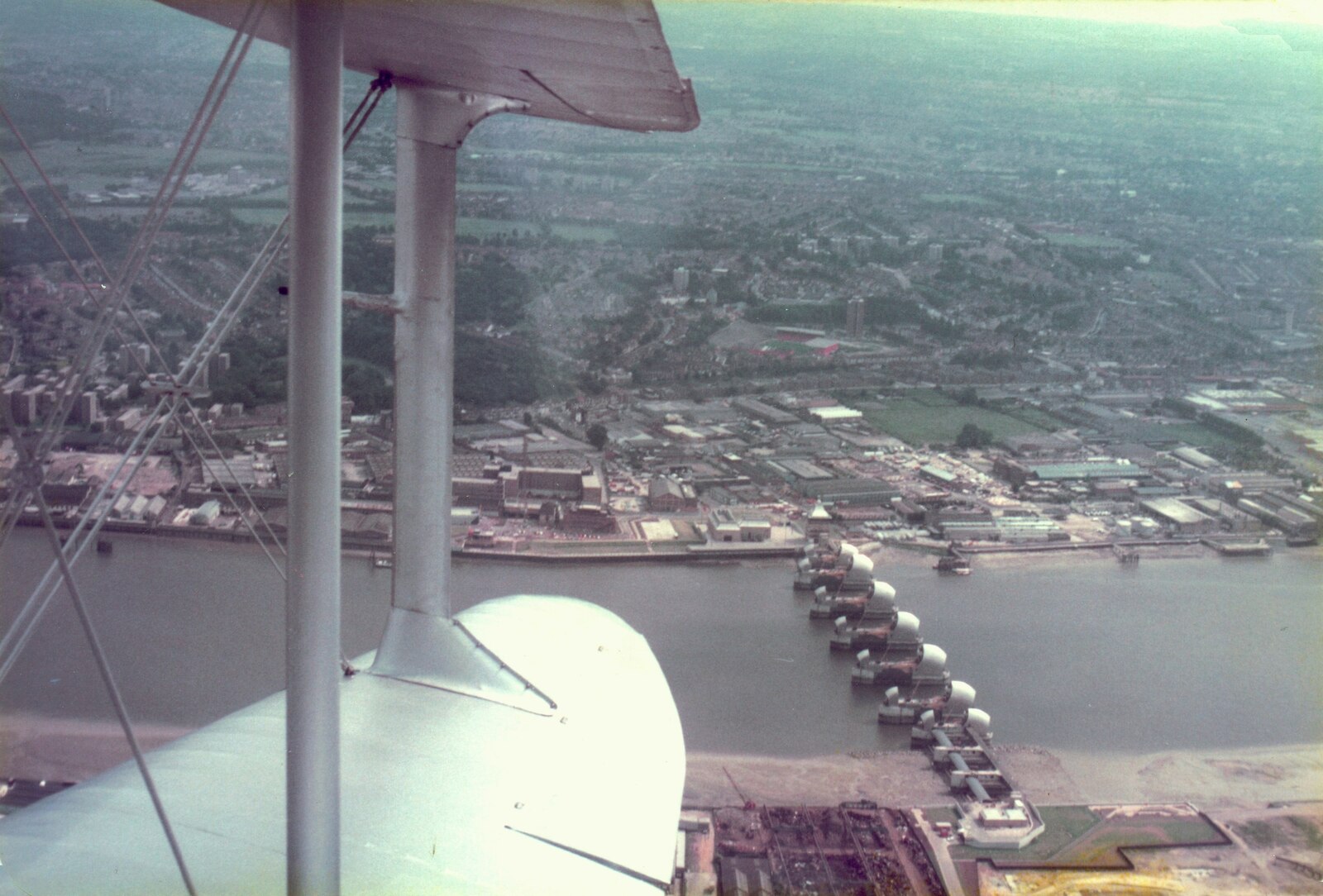
Scaled up by a factor of thousands, that is what the Thames Barrier's main gates do. Each rising sector gate is a hollow steel shell, D shaped in cross section, built of plate up to 40 millimetres thick. Open, it lies in a concrete sill on the riverbed and ships pass over the top. To close, it rotates on trunnions at each end through ninety degrees until the curved face stands across the flow. The four largest span 61 metres, about the width of the opening at Tower Bridge, and the Environment Agency puts each at 3,300 tonnes, as tall as a five storey building when raised. Six rising sector gates sit in the river channels, with four falling radial gates nearer the banks making ten.
Before the government would spend real money on a tap, the idea went to the Hydraulics Research Station at Wallingford, which HR Wallingford's own history says built six physical models between 1968 and 1978, one of them a barrier gate at a twenty fifth of full size. Parliament passed the Thames Barrier and Flood Prevention Act in 1972, nineteen years after the surge of 1953 drowned more than 300 people on the east coast and prompted the whole enquiry. Civil work started in 1974 under a consortium of Costain, Hollandsche Beton Maatschappij and Tarmac, with Davy McKee and Cleveland Bridge building the gates and the machinery that swings them.
The build itself is the part I find hard to picture. Cofferdams were driven up to 24 metres into the riverbed. The sills the gates rest in, the largest of them 60 metres long, 27 wide and about 9,000 tonnes, were cast in a dry dock on the north bank, floated out on the tide and lowered 16 metres to the bed, where The Register says they landed within ten millimetres. In fast moving tidal water, with synchronised winches and a tug, that number is the whole story.
The money is the other half. Inflation touched 24 per cent during the years of the build, and The Register records that no contractor would sign a fixed price. The Environment Agency put the construction cost at 535 million pounds of 1982, three quarters of it from government and a quarter from the Greater London Council. An Open University film made the year it finished says plainly that industrial relations caused many delays, and The Register fills in one cause: a site that opened on twelve hour shifts and then moved to three eights, costing local men their overtime. The gates first worked together in the autumn of 1982 and the Queen opened the barrier on 8 May 1984, a decade after the first pile.
It was expected to close now and then. The Environment Agency's count, correct to November 2025, stands at 221 closures for flood defence since 1982, 119 against the tide alone and 102 against tide and river together. Winter 2013 to 2014 alone took fifty. Each gate takes ten to fifteen minutes to close and the full set about ninety, and a closure holds until the water downstream has dropped back to the level upstream, roughly five hours. The barrier was built to last until 2030. The Agency now says 2070, with a decision on what follows due by 2040, and the Financial Times reported in August 2026 that its officials privately think a replacement may be needed between 2050 and 2060 at no less than 20 billion pounds, against earlier public estimates of six to nine. Reported, not confirmed, but a long way from a gas tap.
The same tap on the Haven
On the night of 5 December 2013 a North Sea surge came up the Haven at Boston in Lincolnshire, overtopped the town's defences and flooded more than 800 properties across 55 streets, by the Environment Agency's count. Boston had the Thames problem in miniature. The Haven is a working port river with coasters going up to the wet dock, and a gate that stopped the sea could not be a gate that stopped the ships.
The answer chosen was Draper's. The Boston Barrier is a single rising sector gate, 25 metres clear across and 11 metres high, which lies in a sill on the bed of the Haven and rotates up on hydraulic rams when a surge is forecast. The Environment Agency calls it a 300 tonne gate. The Institution of Civil Engineers' account has it at 362 tonnes of steel and more than 750 once it is ballasted with water for the lift, which is a reminder that a gate's weight depends on when you weigh it. Dillinger, who rolled the plate, say roughly 470 tonnes of it went in, from 15 millimetres up to 180.
What strikes me is how little of the Thames build was repeated, even though the gate is a cousin. Nothing was cast in a dry dock on the riverbank. Hollandia Infra fabricated the gate in the Netherlands and shipped it across by barge in November 2019, and the joint venture of BAM Nuttall and Mott MacDonald drove it onto its structure with a self propelled transporter. The two rams that lift it weigh 55 or 56 tonnes apiece, depending on whose page you read. A raise takes about 20 minutes in the Environment Agency's release of 2021 and about 40 in its note of 2023; either way, a working morning on the Thames becomes a tea break on the Haven.
The constraints were ones that nobody at Woolwich in 1974 was counting. The concrete around the gate, waterprojectsonline reports, replaced 70 per cent of its cement with ground granulated blast furnace slag, saving roughly 1,250 tonnes of carbon across 6,000 cubic metres; a redesign took 70 piles out of the scheme and 300,000 pounds with them. The control room sits on the first floor so that it keeps working if the defences it controls are overtopped. The barrier was designed to lift the town from a one in fifty chance of tidal flooding in any year to one in three hundred, and to do it for more than 13,000 homes and businesses.
It did not all go to plan. The Dutch trade press expected the gate fully operational by summer 2020; the Agency declared it so in December 2020, after what it called rigorous testing, with test closures every month since. The scheme was announced as 100 million pounds and the wider works finished in 2022; by the Agency's tenth anniversary note on the 2013 floods it had become over 120 million, and Turner and Townsend put the final figure at 124. The first closure against a real tide came on 7 November 2021, at a quarter to five in the morning, with the Agency's project director saying beforehand that flood risk can be managed but not removed.
Two gates, one shape
Set the two side by side and the proportions are odd. The Thames gate is 61 metres across and 3,300 tonnes; Boston's is 25 metres and a tenth of the weight. The Thames took eight years on the river and 535 million of 1982's pounds; Boston took about four and roughly 124 million of today's. The Thames was tested on six physical models over ten years before a spade went in; Boston's gate was drawn, rolled, welded and barged in from abroad as a product. The Thames was built by eighteen or more contractors on shift patterns that upset the men who worked them; Boston's steel came with a carbon count and its concrete with a cement ratio.
Both columns have entries on both sides. Nobody in 1974 wrote down the embodied carbon of 9,000 tonne sills, or had to, and the delays that an Open University film put down to industrial relations are a line in a programme that nobody now can reconstruct. Boston's cost grew by a quarter, and a lift that was twenty minutes in one release is forty in another, which tells you something about how figures on a live scheme move. On the other hand the Thames was built from a kitchen table model by men who had never seen a rising sector gate at full size, and it has shut 221 times and is still what London stands behind. Boston has only been closing against real tides since November 2021, with monthly tests in between to show the gate still swings.
Not every estuary has chosen the gas tap. Up the Parrett at Bridgwater the Environment Agency and Somerset Council are building a barrier on vertical lift gates, two of them 15 metres wide, hoisted straight up in towers rather than rolled up from the bed. That scheme has its own both columns: Wikipedia's figures run from a 30 million pound idea after the 2014 floods to 249 million at 2025 prices, Kier's continuation contract of June 2026 alone was 101 million, the towers were cut from about 25 metres to 15 in a redesign, and the Agency's aim, funding permitting, is a working barrier in 2027. A lift gate needs a tower; a sector gate needs a sill in the bed and a river that will let you build one. Each town answered the question the river asked it.
And the Thames will have to answer again. Whatever replaces Draper's gates, whether a new barrier downstream at Long Reach, a barrier with locks or something nobody has modelled yet, will be designed by people who can walk along the Haven and watch a 300 tonne version of the same idea come up out of the water in twenty minutes. I keep thinking of the model on the table in Wood Green, and of how many tables, in how many towns, it has sat on since.
*Image: The Thames Barrier seen from a Dragon Rapide, Stefan Czapski, 1986, CC BY-SA 2.0, via Wikimedia Commons.*
Comments