
In May this year, a 500 tonne steel vessel just over thirteen metres long was carried into the second reactor building at Hinkley Point C, turned upright by a crane working inside, and lowered onto a support ring with 40mm of clearance on each side. EDF's own account of the lift gives the gap as 40mm either way, and NucNet repeated it. That is not much more than the width of your fist. The vessel was a reactor pressure vessel, the steel container the nuclear reaction sits inside, and the operation ran across two days, finishing on the afternoon of Friday 29 May.
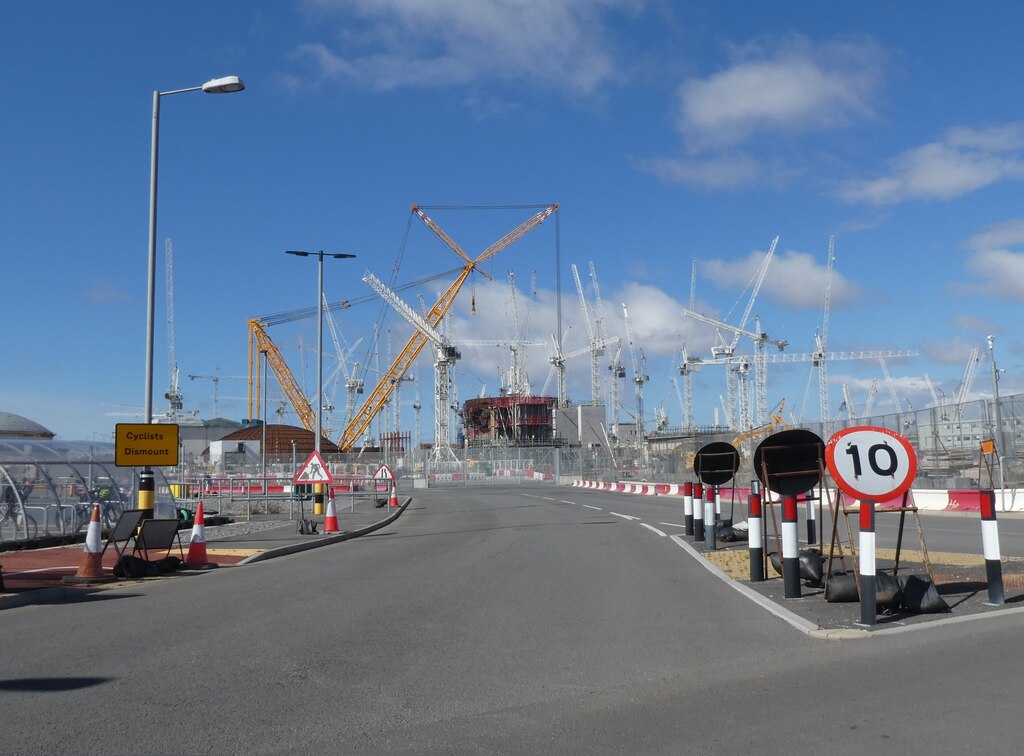
What got the vessel to the building, and what has done most of the heavy lifting at Hinkley Point C since 2019, is a crane called Big Carl. It was built for this site. Nothing in the world could do the job, so Sarens, the Belgian heavy lift firm, built something that could.
Ninety years earlier, on the other side of the world, Dorman Long of Middlesbrough had met the same problem on a bridge and answered it the same way. Two cranes that could only ever work on one structure, because the structure was the thing they ran on.
A crane with one client
Big Carl's proper name is the Sarens SGC-250. Sarens named it after Carl Sarens, the company's director of technical solutions, and unveiled it at the inland port of Ghent in November 2018, by KHL's report of the launch, with Hinkley Point C already named as its first job. In its tallest configuration it stands 250 metres. On its main boom it lifts 5,000 tonnes at a radius of 40 metres, a figure The Construction Index and KHL both give and that EDF turns into 32 single storey houses in one go.
The numbers underneath it are the ones I keep returning to. It is held down by 52 counterweight containers of 100 tonnes each, filled with ballast found locally once the crane arrived. Twelve Caterpillar engines in six power packs drive the slewing and hoisting, with full redundancy, by Sarens' own account at the launch. It sits on a double ring of track and swings through a full circle, but it cannot crawl: at Hinkley it has three lifting positions joined by straight rails, and World Nuclear News put the track laid for it at around six kilometres.
It came from Belgium in 280 separate loads through Avonmouth, by both World Nuclear News' and The Construction Index's count, and took three months to put together on site. Before it left, Sarens expected it to place around 600 prefabricated pieces over four years; by the time it was ready to start in September 2019 the figure given was 700. The four years have become seven and counting.
What the scale is for
In December 2023, Big Carl lifted the dome onto the first reactor building: a steel cap of 245 tonnes, 47 metres across and 14 metres tall, welded together on site from 38 prefabricated panels, by EDF's own figures. The lift started at 07:20 on 15 December and the dome was down in a little over an hour. The job needed raw capacity and a weather window, and not much else.
The reactor vessel lift in May was the opposite kind of problem. Big Carl's job was to get the vessel to the building and roughly into position. The last few centimetres, onto a ring with a fist's width to spare, belonged to the polar crane working inside the building. On the first unit, EDF says, the vessel went in under a large temporary overhead lifting system; using Big Carl for the second unit saved space, time and money, and the second unit is going up 20 to 30 per cent faster than the first.
The other column is as real. Construction began in March 2017 and was supposed to be finished in 2025, as The Construction Index reminded its readers when it reported, in September 2025, that thirty tower crane operators at the site had been given redundancy notices because that part of the work was winding down. In January 2024 EDF put the cost at £31bn to £34bn in 2015 money, up from £25bn to £26bn two years earlier and from roughly £18bn when the project was approved, by The Construction Index's account, and gave three dates for the first reactor: 2029, 2030 or 2031. I have not seen anyone accuse the crane of being late.
Two cranes that crept
On 24 March 1924 the New South Wales government let the contract for a bridge across Sydney Harbour to Dorman Long and Company of Middlesbrough, for £4,217,721 11s 10d, the figure the Public Works Department's report and the Australian Science and Technology Heritage Centre both carry. The design was a two-hinged steel arch of 503 metres, from John Bradfield's general scheme and Ralph Freeman's detailed calculations. The arch alone weighs 39,000 tonnes and the bridge as a whole, with its approach spans, 52,800 tonnes, held together with about six million rivets.
There was no way to prop an arch like that off the water. The answer was to build each half out from its own shore as a cantilever, tied back by cables anchored in the rock, and to put a crane on top of the half-arch that could lift the next piece into place and then move out onto the piece it had just lifted. The two creeper cranes were electrically driven and weighed 580 tonnes each, by the NSW State Archives' and the Dictionary of Sydney's accounts, and could lift 122 tonnes, the Heritage Centre's figure. They ran along the top chords of the arch itself.
Dorman Long drew them at home; a company blueprint dated July 1928 for the erection of a creeper crane on site survives in Teesside Archives. Freeman told the Institution of Civil Engineers in 1934 that they cost roughly £45,000 in Britain and £50,000 by the time they stood in Sydney, a figure I have only from Engineers Australia's heritage register.
The steel came out of Dorman Long's works on the Tees and was made into members at purpose-built workshops at Milsons Point on the north shore, then floated out on barges and lifted straight off the water. Each half-arch was held back by 128 wire ropes, 70mm thick and about 366 metres long, by the Heritage Centre's figures, running down into U-shaped tunnels cut into the rock behind the springings; Grace's Guide gives the same count and describes the tunnels as 25 feet by 6 feet, driven 132 feet into the rock at 45 degrees. As the arches reached further out the cables were tightened again and again against the growing load.
The night the halves met
The south half was kept ahead of the north to help with alignment. On 19 August 1930 the two halves touched at a quarter past four in the afternoon and were fully closed by ten that night, by the NSW State Archives' account, which the Dictionary of Sydney repeats. The next morning flags flew from the jib of each creeper crane. The closing was done by paying out the cables and letting the halves down onto each other at the bottom chord, then jacking load into the top chord to make a true two-pinned arch, after which the cables came out.
Then the cranes did something I find quietly remarkable. They turned round and worked their way back down the arch they had just built, hanging the deck hangers and the deck steel beneath them as they went, from August 1930 to June 1931. The longest hangers were 192 feet, by Grace's Guide, and flexible enough to need special handling. Sixteen men died building the bridge, by the Institution of Civil Engineers' count. The bridge opened on 19 March 1932, eight years almost to the day after the contract was signed.
What became of them
Here the records are untidy, and I would rather say so than tidy them. The Institution of Civil Engineers says the creeper cranes were dismantled once the deck was finished in 1931, and there is a 1932 photograph by Edward Cash, taken from Lavender Bay and held by Moore Theological College, titled as cranes disassembling the creeper on the north side. Four smaller cranes then rode the arch for painting and maintenance for the next 65 years, carrying two people each, until a 1997 refurbishment replaced them with new ones built by EW Cox of Melbourne, as Cranes Today reported at the time. The conservators who later worked on those four, in a paper for the Australian Institute for the Conservation of Cultural Material, describe them as the cranes that built the arches between 1928 and 1932 and then stayed for maintenance until they were retired.
Either the creepers were rebuilt into something smaller, or the story has drifted from one set of cranes to the other across sixty years, and I could not settle which from here. What is not in doubt is the ending. Heritage approval for taking the four down was conditional on conserving two of them, with at least one on permanent public display. One was kept by the Roads and Traffic Authority for display, one went to the National Museum of Australia in 2007, and two were disposed of.
Side by side
Set the two beside each other and the same shape appears. A contractor with a job nothing on the market could do. A machine designed for that job and no other, drawn by the contractor's own people. A name attached to a person rather than a model number, in Carl Sarens' case, and to a habit of movement in the creepers'. An afterlife nobody wrote into the contract.
The differences are real too, and they cut both ways. Dorman Long's cranes ran on the bridge's own chords and were useless the moment the deck was in; their value was spent in three years and nobody pretended otherwise. Big Carl is a product, the first of Sarens' third generation of ring cranes by KHL's description, and in principle it could be shipped in 280 loads to the next client. Whether there is a next client who needs 5,000 tonnes of lift in one place for seven years is a different question. Nobody has said in public where Big Carl goes when Hinkley Point C is finished; EDF says only that what has been learned on the second unit will carry to Sizewell C.
On the other side, the creeper cranes did their work with riveters out on bare steel and sixteen funerals. Hinkley Point C lifts its 500 tonne vessels with a workforce that goes home, under a regulator and a review process Dorman Long never met, and with a cost and a timetable that every newspaper in the country keeps a tally of. The Sydney contract is remembered to the penny because that is how a tender was written down. The Hinkley figures move every couple of years because they are watched.
Two cranes came back down the arch in 1931 and were in pieces on the north side the following year, give or take the question of what became of those pieces. Ninety years on, the biggest crane ever built stands on a ring of track in Somerset with a few hundred lifts left in its contract and no announced next job. I do not know which is the better ending for a machine built once, for one thing. I am not sure the people who built either of them gave it a thought.
*Image: A forest of cranes at the Hinkley Point C construction site, Roger Cornfoot, 2022, CC BY-SA 2.0, via Wikimedia Commons.*
Comments