

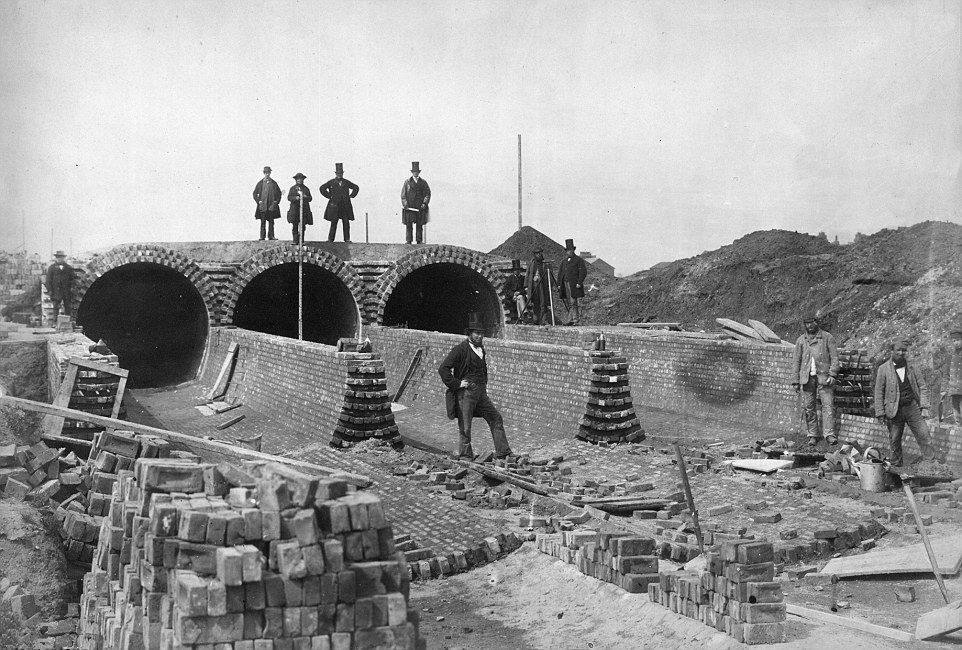
There is a photograph from around 1860 of a building site in east London. Three brick tunnels sit side by side, each big enough to drive a cart through, with stacks of bricks waiting in the foreground. Four men in top hats stand on top of the arches as if they have just bought them. A few labourers lean on their shovels and look at the camera. Nothing in the picture tells you that you are looking at a toilet.
That is exactly what it is. The tunnels are part of the Northern Outfall Sewer, and the man usually identified on the right of the group is Joseph Bazalgette, Chief Engineer of the Metropolitan Board of Works. More than a century and a half later, those same bricks are still carrying London's waste.
The summer the river won
In the hot summer of 1858 the Thames simply gave up. For centuries London had emptied its cesspits, its streets and its lost rivers into it, and then drunk from it. That year the heat baked the waste on the foreshore, and the smell reached the riverside Houses of Parliament. The London Museum describes MPs rushing a bill through to pay for a proper sewer system. Cholera had been killing Londoners for years. It took the smell reaching Westminster to unlock the money.
Bazalgette was the man given the job. According to the London Museum he reviewed 137 proposals before settling on his plan: 1,100 miles of street drains feeding 82 miles of brick main sewers, which carried everything to intercepting sewers running east, and then to pumping stations at Deptford, Crossness and Abbey Mills. The whole job took 318 million bricks, dug largely by hand. Demand for bricklayers pushed their wages up by a fifth.
He also insisted on Portland cement, which was stronger and more water resistant than the alternatives, and he checked the work personally. His signature is on the drawings.
Building for a London that did not exist yet
The part I keep coming back to is the size. The line usually attributed to him is that "we're only going to do this once, and there's always the unforeseen", and that he doubled the diameter of the pipes to allow for it. I have not found those words in anything he wrote, so I would hold the exact quote loosely. The decision itself is on firmer ground. The London Museum says his tunnels are still in use partly because he built them far larger than originally needed, anticipating the growth of the city.
He was right to. When he died in 1891, inner London had about 5.5 million people, more than double the number when he designed the system in the 1850s, and his sewers were still coping.
What I love about this is how unglamorous the call was. Nobody stands on a sewer and admires the extra width. The cost of building bigger lands on your budget, in your lifetime, and the benefit lands on people you will never meet. I hear the same tension in conversations now, about programmes that get specified for the opening day rather than the next fifty years.
He did not get everything right
His system pushed the waste east and dumped it, untreated, into the lower Thames. In 1878 the pleasure steamer Princess Alice sank at Gallions Reach near Woolwich, close to the outfalls, and around 640 people drowned. The London Museum notes that some who survived the sinking later died from swallowing the water. That disaster drove the move to proper sewage treatment.
The second once
His sewers also carry rainwater, and when London's population and paved surfaces outgrew even his generous sizing, heavy rain began overflowing the system straight into the river. The fix is the Thames Tideway Tunnel. It runs 25 kilometres under the river, 7.2 metres wide and between 33 and 67 metres deep, and it is now connected across all of its sites. Tideway says it will cut spills into the Thames by around 95 percent, at a cost of about £4.5 billion.
It does not replace Bazalgette's system. It catches what spills out of it. The two work together, one built with steam and shovels, the other with tunnel boring machines, a lifetime and a half apart.
I keep looking at the men on top of those arches. They had no way of knowing their tunnels would still be working when the next super sewer was dug underneath them. Somebody on a site today is making the same sort of call, and most of us will never know their name either.
*Image: Construction of the Northern Outfall Sewer in east London, photographer unknown, c. 1860, public domain, via Wikimedia Commons.*
Comments