

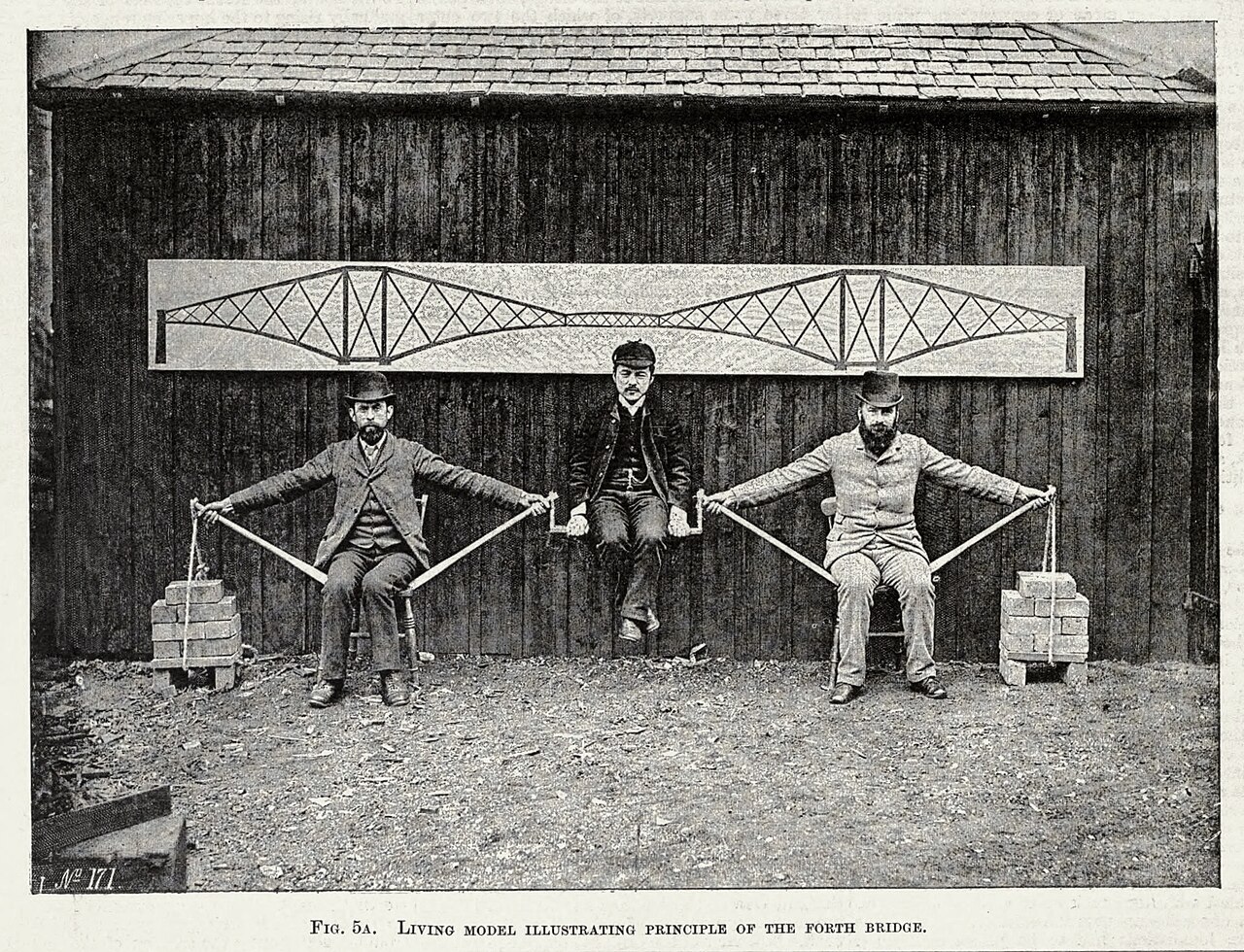
There is a photograph of the Forth Bridge taken before the bridge existed, and there is no steel in it. Two men sit on chairs, arms stretched out, each gripping a stick that butts against his chair. Ropes run from their outer hands down to piles of bricks. Between them, on a short plank slung from their inner hands, sits a young man in a good suit, looking at the camera as if being held in the air were an ordinary way to spend an afternoon.
The young man was Kaichi Watanabe. The two on the chairs are captioned as John Fowler and Benjamin Baker, the engineers who designed the bridge. Fowler was 69 that year. I will leave you to look at the photograph and decide.
What the chairs are doing
Baker used this arrangement, which he called a living model, in a lecture at the Royal Institution in London in 1887, and wrote it up for Chambers's Journal the following year. The men's arms are the cantilever arms, in tension. The sticks are the bottom members pressing against the towers, in compression. The chairs are the towers on their piers, and the ropes and bricks are the anchorages that stop the whole thing tipping inwards. Put a load on the plank and the arms and ropes pull, the sticks and chair legs push, and nothing moves.
Then he asked the room to scale it up. Imagine the chairs a third of a mile apart, he said, and the men's heads more than 300 feet in the air. Imagine the sticks as steel tubes twelve feet across. In the Chambers's piece he put numbers on it: about 4,000 tons of pull on each arm, more than 6,000 tons of thrust in each stick, and roughly 25,000 tons on the legs of each chair. The man on the plank, in the real bridge, is a railway train.
What I love about this is who it was for. Everyone in that room knew that eight years earlier the Tay Bridge had gone into the river with a train on it, and that Thomas Bouch's original Forth design, a suspension bridge, had been thrown out because of it. Bouch had allowed for a wind pressure of 10 pounds per square foot, on the advice of the Astronomer Royal. After the Tay inquiry the Board of Trade asked for 56. The public had been told engineers knew what they were doing and had then watched a bridge fall down, and two men on chairs is an argument you can check with your own arms.
The man in the middle
Watanabe was not a prop. He had come from Japan to the University of Glasgow, taken his degree in civil engineering in November 1886, and gone to work on the bridge as a foreman. In 2007 the Bank of Scotland put the photograph on its £20 note, so for a while a Japanese engineer sat in Scottish wallets as the load on the Forth Bridge.
The V&A says there was an earlier version of the model from 1885 with a boy in the middle. In that one the strings are thin, the chairs are tilted and the boy looks worried. By 1887 the ropes are thicker, the chairs are level, and the man on the plank looks as though he could sit there all day. Even the model had to be engineered twice.
The real thing went up in steel from 1883. Network Rail puts it at around 53,000 tonnes, held together by 6.5 million rivets, with 4,600 men on the job at its peak. Each main span is 1,700 feet, and the arms reach 680 feet out from each tower, exactly as the chairs said they would. Wilhelm Westhofen, an engineer on the job who wrote the first account of the bridge in 1890, counted 57 men killed; local historians have since put the figure at 73 or more. The Prince of Wales drove the last rivet, gold plated, on 4 March 1890, and Network Rail gives the cost as roughly £3 million in the money of the day.
The bridge is still there, carrying around 200 trains a day by the Forth Bridges' own count. So is the photograph. And I keep coming back to the same thought. Watanabe is the only person in it doing nothing. He is simply being heavy, on purpose, so that everyone watching can see where the weight goes.
*Image: Benjamin Baker's living model of the Forth Bridge cantilever, with Kaichi Watanabe seated in the middle, unknown photographer, c. 1887, public domain, via Wikimedia Commons.*
Comments