

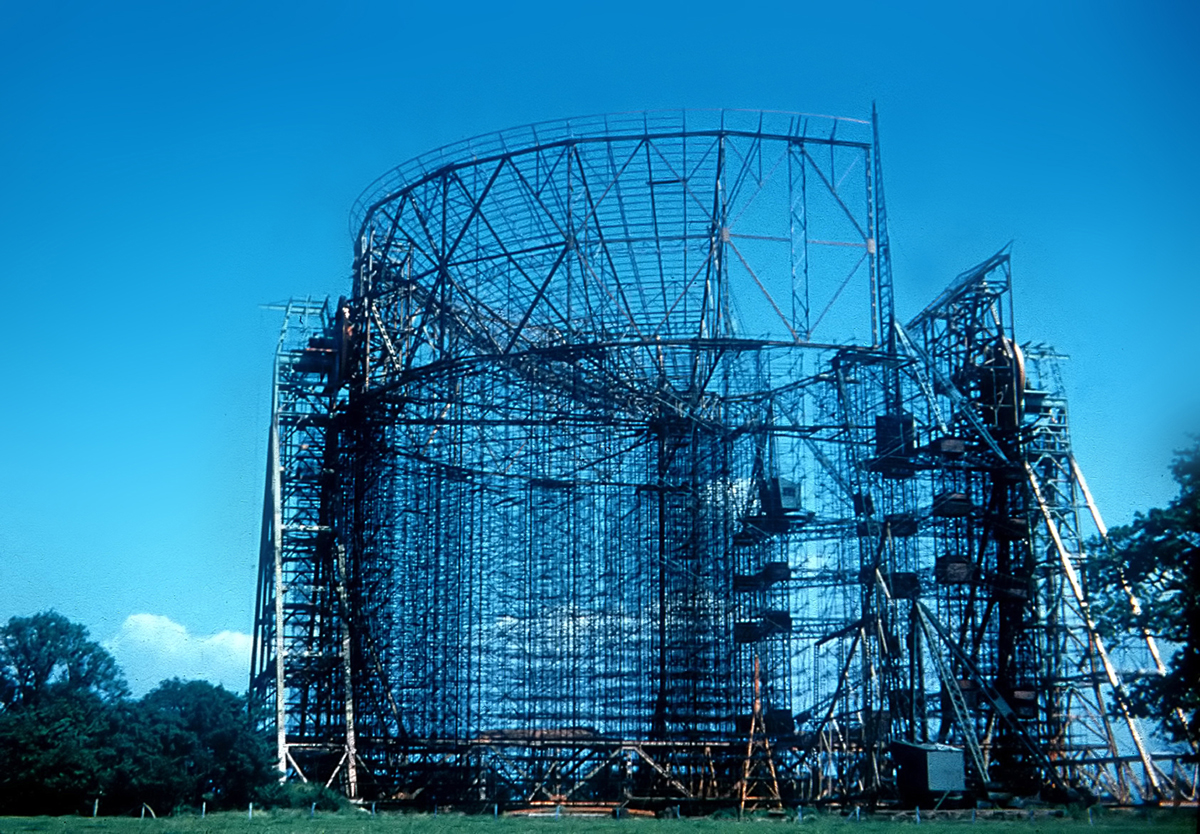
Every time the Lovell Telescope at Jodrell Bank tips its great bowl towards a star, it does so on the gun turrets of two battleships.
That is not a figure of speech. In 1950 Bernard Lovell and his engineer, Charles Husband, bought two drive racks from the 15-inch gun turrets of HMS Revenge and HMS Royal Sovereign, both of which were being broken up. Husband designed the telescope's two elevation bearings around them. Grace's Guide, the University of Manchester and Jodrell Bank's own history all tell the same story, and the telescope still works in a Cheshire field today.
Where the steel had been
What I love about this is where the ships had come from. Both were launched in 1915, carrying eight 15-inch guns in four twin turrets. Revenge fought at Jutland.
Royal Sovereign missed that battle, but spent the last years of her life on loan to the Soviet Navy as the Arkhangelsk, escorting Arctic convoys, and only came home in February 1949. Both went to Thomas Ward's breaker's yard at Inverkeithing on the Forth. Within a year or so, part of each was on a lorry to Cheshire.
Think about what a turret is. It is a machine for swinging something enormous smoothly and then holding it dead still, and the Navy had spent forty years perfecting it. That was Husband's problem too. Lovell recalled in his memoirs for Web of Stories that Husband, a Sheffield consulting engineer, said it was "about the same problem as building a swing bridge over the Thames".
The swing bridge Husband built weighs about 3,200 tonnes, with 1,500 tonnes of it in a bowl 76 metres across. The whole thing turns on a circular railway track 107 metres in diameter, and Jodrell Bank's engineers say it runs on 64 wheels, each weighing over a ton. The turret racks sit on top of the two towers, and the bowl nods on them.
A telescope redesigned while it was being built
The racks were the cheap part. Almost nothing else was. The bowl was first planned as open wire mesh, fine for long wavelengths. Then in 1951 astronomers detected the 21 centimetre hydrogen line, and Lovell decided his telescope had to see it.
That meant a solid steel surface and a redesigned structure behind it. Jodrell Bank's own history says the surface was made from around 7,000 welded panels, each two millimetres thick, and that the contractors were already setting up their cranes when the change came through.
Steel prices were climbing at the same time. Lovell had once talked of a telescope for about £60,000. The grant from the Nuffield Foundation and the government, agreed in 1952, was £335,000. The final bill came to roughly £700,000, in pounds of the 1950s. As a former QS I notice that the first figure never had a design behind it, and the last one had three.
The Public Accounts Committee came to look. Newspapers called the project Lovell's Folly. The Physics Today obituary records that court cases over unpaid fees were looming, and Lovell remembered his own engineer telling him that if the university would not write to The Times, "I shall have to drag it out of you in the witness box".
The rocket that paid for it
The telescope saw first light on 2 August 1957. Nine weeks later the Soviet Union launched Sputnik. The bleeps could be heard on a cheap receiver, but the rocket that carried it was an intercontinental ballistic missile, and the question that mattered was whether radar could see one of those coming.
Lovell's team rushed the radar they used for meteor echoes onto the dish, and on the night of 12 October 1957 it found the carrier rocket. Jodrell Bank's history describes it as the only instrument in the West that could. Lovell's Folly became a national asset almost overnight.
The debt took three more years to clear, and Lovell told the ending himself.
Lord Nuffield rang and asked, "How much money is owing on that telescope of yours?" Lovell said fifty or sixty thousand pounds. "Is that all? I'll send you a cheque."
The last £50,000 was paid in May 1960. "End of conversation; end of debt. Fairytale ending."
The racks that turned guns at Jutland, and that spent four years under a Soviet flag in the Arctic, now tip a bowl towards pulsars. I keep wondering what the man at the breaker's yard made of the order.
*Image: Steelwork of the Mark I telescope's bowl under construction at Jodrell Bank, photographer unknown, 1950s, copyright-free with attribution to Jodrell Bank, University of Manchester (Wikimedia Commons Attribution licence), via Wikimedia Commons.*
Comments