
I keep coming back to the image of Marc Brunel standing in Chatham Dockyard with a rotten plank in his hands, looking at the tunnels a shipworm had bored through it. He wasn't there to study biology. He was there because the Royal Navy's hulls kept failing, and the culprit was a creature barely anyone could see at work.
Teredo navalis isn't a worm at all. It's a small clam that drills into submerged timber using two hard, ridged plates at the front of its body, almost like a drill bit, then lines the tunnel behind it as it goes. The Brunel Museum, which tells the story as one worth repeating rather than one it can fully prove, says this is what caught Brunel's eye: not the damage, but the method. The creature never collapsed its own tunnel. It built the lining into the act of digging.
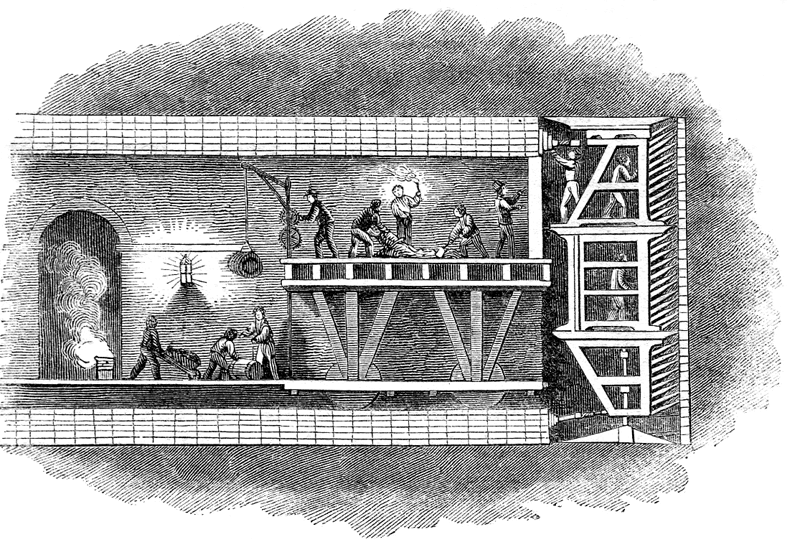
By January 1818 Brunel had turned that observation into a patent, filed jointly with the naval officer Thomas Cochrane, Earl of Dundonald. The result was the tunnelling shield: an iron frame of twelve sections, each three storeys high, giving 36 individual cells, each weighing well over seven tons. One man worked alone in each cell, holding back the face of the ground board by board, digging a few inches, then replacing the board before moving to the next. When a cell's miner had cleared his section, jacks pushed the whole frame forward, and bricklayers followed close behind, lining the tunnel exactly as the shield advanced, just as the shipworm had lined its own.
It is a lovely piece of engineering logic and I don't think it gets nearly enough credit next to the bridges and viaducts of the period. Nobody designs a structural support system by copying a mollusc unless they've genuinely sat and watched the mollusc work.
The shield went to work on the Thames Tunnel, between Rotherhithe and Wapping, from 1825, and it was tested hard almost at once. A first flood in May 1827 came after, on one account, some 549 feet of tunnel already dug. A second, far worse, arrived on 12 January 1828. Six workmen died.
Isambard Kingdom Brunel, who had taken over as resident engineer at just twenty when the original engineer fell ill, was in the shield at the moment the water broke through. A falling timber trapped his leg and he was pulled out, by most accounts barely, by a contractor named Beamish. His own diary afterwards records him as "laid up quite useless for fourteen weeks and upwards".
Money ran out not long after. The tunnel was bricked up behind the shield where it stood and left, unfinished, for around seven years. I find that detail harder to shake than the flood itself: a shield built on the model of a creature that never stops digging, parked mid-river and sealed up like nothing had happened.
It did eventually finish. Work resumed once further funding was secured, and the tunnel opened in March 1843, eighteen years after it started, having cost £454,000 to dig and another £180,000 to fit out, a total that dwarfed the original costings. As a quantity surveyor, I'd have hated writing the final account on this one: nobody had tunnelled under a navigable river before, so nobody had really known how to price it.
What stays with me isn't the money or even the deaths, grim as they are. It's that the method behind the first tunnel ever built under a navigable river was lifted, cell for cell, from something the Navy had spent years trying to kill. Brunel looked at a pest and saw a structural engineer.
*Image: Diagram of Marc Brunel's tunnelling shield used to build the Thames Tunnel, anonymous, 19th century, public domain, via Wikimedia Commons.*
Comments