
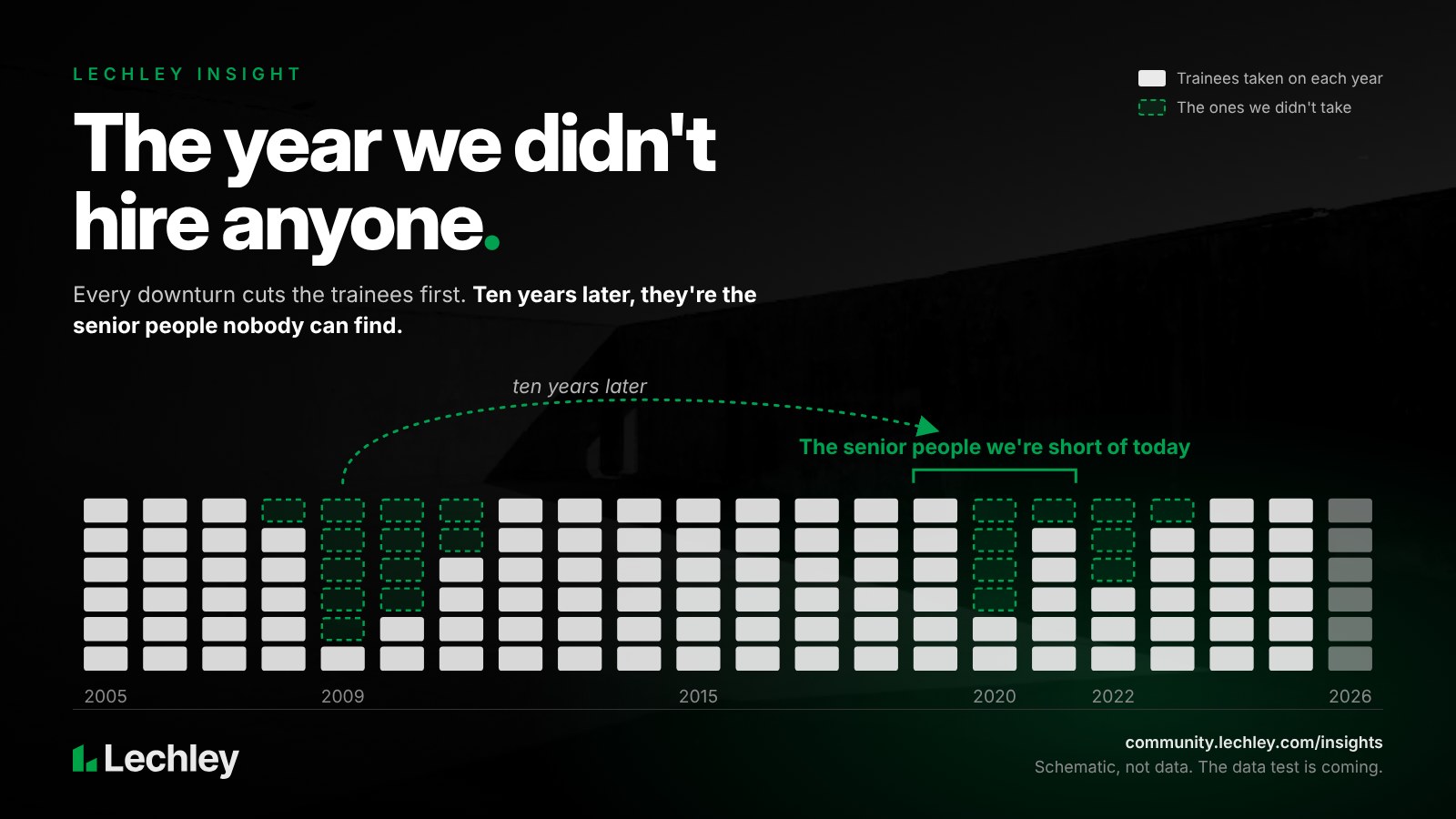
Ask a construction director what they did in 2009 and most of them will tell you about the jobs that stopped. The scheme that was ready to start on site and never did. The client that went quiet. The framework that got re-tendered at prices nobody could build to.
Very few will tell you about the trainees they didn't take on that year. It wasn't a decision anybody remembers making. It was a line in a budget review, somewhere between the fleet and the Christmas party, and it went through without a conversation.
I've been thinking about that line a lot this week, because I'm fairly sure it is the reason my phone rings.
What the phone calls sound like
I run a retained executive search firm in UK construction. Most of my work is finding people with fifteen to twenty-five years behind them: commercial directors, operations directors, pre-construction leads, the people who can run a region or carry a programme.
Here is the shape of a typical brief. The client wants someone with around fifteen years in. They want the right sector, the right forms of contract, a track record on jobs of a certain size, and a bit of grey hair but not too much. Reasonable asks. Twenty years ago I'd have had a long list within a week.
Today the list is shorter than it should be, and it is the same list every time. The same forty or fifty names in a region, all of whom have been approached three times this year already, all of whom know exactly what they are worth. The price keeps climbing, the clients keep complaining about the price, and everybody blames the market.
I don't think it's the market. I think it's the calendar.
Count backwards
Somebody with fifteen years' experience in 2026 started in 2011. Somebody with seventeen years started in 2009. Somebody with twenty started in 2006 and spent their formative years watching the industry fall over.
Now think about what those years looked like for a trainee.
The graduate who was due to start in September 2009 often didn't, because the intake was pulled in the spring. The apprentice who had been promised a place found the promise withdrawn. The ones who did get in were the first to be let go when the order book emptied, because they were the cheapest to release and the easiest to justify. A fair number of them went into other industries, settled, and never came back.
That is not a theory. It's who is missing from my shortlists.
The industry didn't lose those people. It never had them. And a cohort that was never hired cannot be recruited later, at any salary, by any search firm. You can only fight over the people who were trained, which is exactly what everybody is now doing.
It happened again
If this were just about 2008, you could put it down to a once-in-a-generation shock and move on. But the same reflex kicked in twice more in the space of three years.
In 2020, intakes were paused "until things settle". Site visits and placements stopped, which for a lot of young people was the only way they'd ever seen a site. Then in 2022 the cost of materials and borrowing went through the roof, margins went the other way, and "development" became a word that boards used in the past tense.
Each of those decisions made sense in its own twelve months. I'm not going to pretend otherwise. If you are a main contractor looking at a 2% margin and a shrinking order book, nobody is going to argue that you should take on thirty graduates you can't put to work.
But put the decisions side by side and you've cut a notch out of the age profile of the industry every few years. The 2009 notch has just arrived at the senior end. The 2020 notch is on its way. The 2022 one is behind it. We are not short of people. We are short of people in specific years, and the years were chosen by the industry itself.
The 206,000 is not one number
The CITB says construction needs 206,000 additional workers between now and 2030. Other estimates run much higher. Whatever figure you prefer, it gets presented as one big gap, as if you could fill it with one big recruitment campaign.
It isn't one gap. It's a series of them, each with a date on it, and each one explained by a decision the industry made a decade earlier.
I want to be careful here, because "it looks like this from my desk" is not evidence, and I've spent enough of my career listening to confident people being wrong. So this term I'm putting the hypothesis to a group of economics students who will test it against publicly available data. Does training intake fall faster than overall employment when the industry turns down? Can you see 2008, 2020 and 2022 in the age profile of the workforce today? Which trades and professions show the deepest notches?
If the numbers say I'm wrong, I'll say so publicly. If they say I'm right, then this industry has had a forecasting tool sitting in front of it for twenty years and never used it.
Why we do it
There's a reason training is always the first thing to go, and it isn't stupidity. It's how we think about what a trainee is.
Most boards see a graduate or an apprentice as a cost that only starts to pay back once they're "ready". On that view, cutting the intake in a bad year is pure saving. You've removed a cost and lost nothing, because the person wasn't producing anything yet.
I think that view is wrong, and I think the industry already knows it's wrong, because it would never apply the same logic to a building.
Every site manager knows what happens if you rush the foundations to save a few weeks. The building looks fine for a while. Then you get to the top floors and it won't carry the load. Nobody on site thinks the foundation weeks were wasted because nothing visible came out of the ground. Yet the same industry does exactly that to its own workforce every time the order book wobbles. We skimp on the foundations, then act surprised when there's nothing to hold the building up fifteen years later.
I trained as a Quantity Surveyor and spent my early career on site with tier-one contractors. Nobody was buying a finished product when they took me on. They were buying potential and the ability to learn, and the return on that came over decades, not quarters. Education gets a young person to their driving test. The industry teaches them to drive. Cut the lessons and you don't save money. You just produce fewer drivers, ten years late.
What I'd actually do
I'm not asking for a government scheme. I've written around eighty letters to government this year and had one reply, so I'm not holding my breath for one anyway. This is a boardroom problem, and it can be fixed in a boardroom.
Three things.
First, hire into the downturn, not out of it. A recession is the one time the best school leavers and graduates are available, cheap and not being fought over by anybody else. The firms that took people on in 2009 and 2020 now own the scarcest talent in the market. That wasn't luck. It was a decision, and it's available to anyone who makes it next time.
Second, put the intake on the board pack. Most boards see the order book, cash and margin every month and the trainee numbers once a year, if at all. Report them side by side, every month, and ask the same question of both: what does this look like in ten years? You'd never let the order book go to zero without a conversation. Don't let the intake.
Third, go back for the ones you lost. The cohort that went into insurance, logistics or the railways in 2009 is now around forty, settled, and very employable. Some of them would come back for a route that doesn't start them at the bottom. Nobody is asking them. I'd start there before I spent another pound on a campaign aimed at sixteen-year-olds.
The next one
The next downturn is coming. I don't know when, and neither does anyone else, but I've been in this industry long enough to know it always does.
When it arrives, every board in construction will sit down with a budget and find the same line, somewhere between the fleet and the Christmas party. It will look like the easiest thing in the room to cut, and in that year it will be.
Ten years later, somebody like me will be sitting with a brief for a commercial director with fifteen years' experience, looking at a list that's too short, and being told it's the market.
It isn't the market. It's the year you didn't hire anyone.
I turn 55 tomorrow. I've watched this happen three times. I'd quite like to be around for the one where we don't.
Comments