
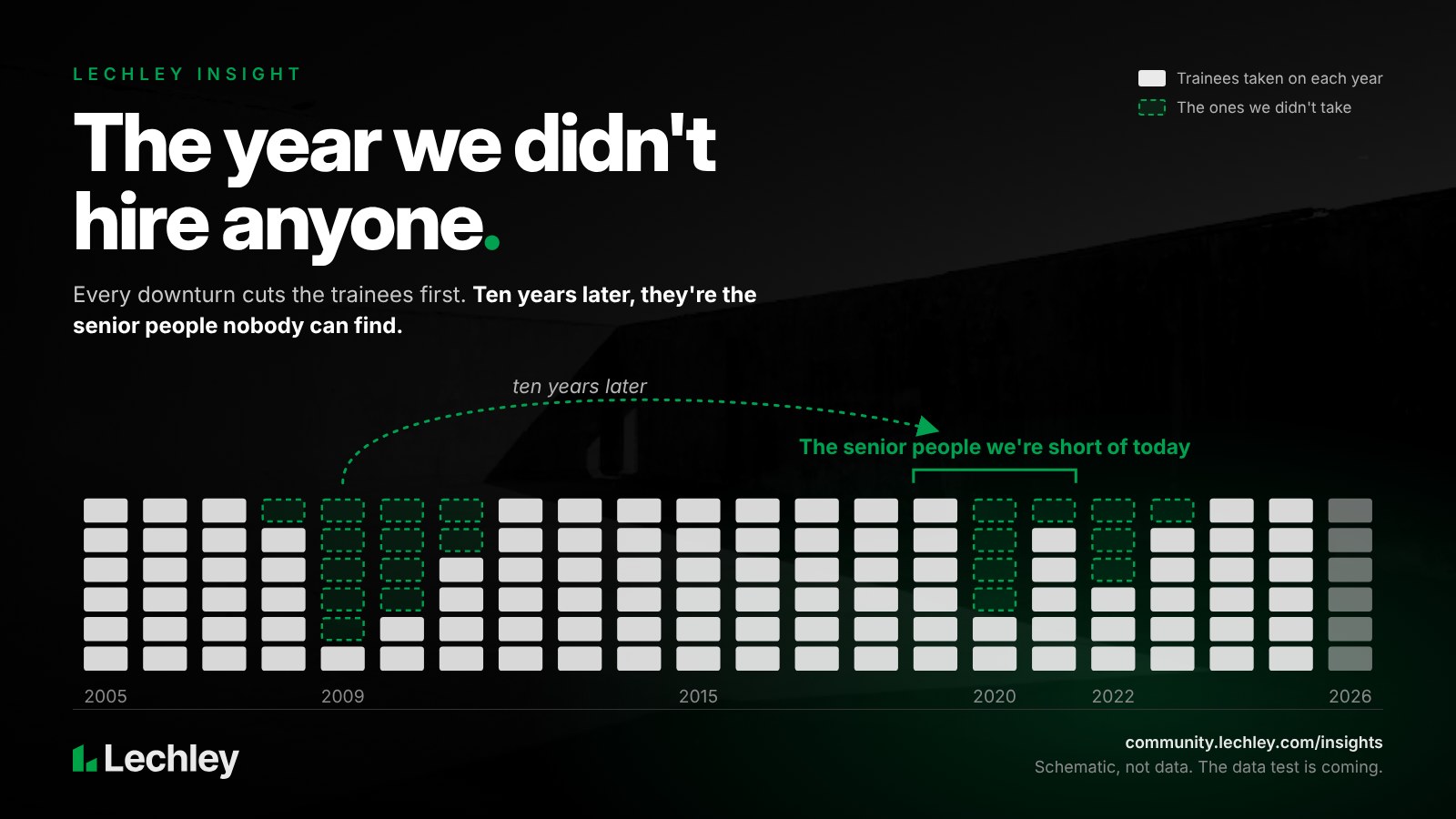
Every time this industry hits a downturn, the same line on the budget goes first. It isn't the head office. It isn't the fleet. It's the training.
Graduate intakes get paused. Apprentice numbers get trimmed. The early careers manager is asked to "hold off this year". It feels prudent at the time, and on a twelve-month view it is. Nobody is going to be short of a trainee quantity surveyor in the middle of a recession.
The bill arrives about ten years later.
The shortage has a shape
We talk about the skills shortage as if it were one number. The CITB says the industry needs 206,000 additional workers between 2026 and 2030. Other estimates run far higher. Whichever figure you use, it gets presented as a single gap that needs filling.
I don't think it is one gap. I think it is a series of them, and each one has a date on it.
A cohort that never got hired in 2009 is not a cohort of trainees today. It is a cohort of 35 to 40-year-olds who should now be senior project managers, commercial managers and the first generation of regional directors. If they were never brought in, or were brought in and then let go when the work dried up, they aren't sitting in the market waiting for a call. They are in another industry, and they are not coming back.
Then COVID paused intakes again, and placements and site visits stopped. Then the cost shock that followed the war in Ukraine squeezed margins hard enough that "development" became a dirty word in plenty of boardrooms. Each of those decisions made sense in its own year. Together they cut a notch out of the age profile every few years.
Why this matters to anyone hiring senior people
From where I sit, the market behaves exactly the way you would expect if this were true.
At the very top there is a generation with thirty-five or forty years behind them. Many of them are tired, physically worn and starting to look at the door. At the bottom there is real interest from young people, more than the industry admits. In between is where the conversations get hard. A client asks for someone with fifteen years' experience, the right sector and the right contracts, and the field is thinner than it should be for an industry this size.
That is not a pay problem, and it is not something a better job advert solves. You can't recruit a cohort that was never trained. You can only fight over the people who were, which is why the same few names come up on every shortlist and why the price of them keeps climbing.
It is a hypothesis, so let's test it
I want to be careful here, because "it feels like this from my desk" is not evidence. So this term I've been asked to set questions for a group of second-year economics students working with publicly available data. Their job is to look at the numbers and say plainly whether they confirm or deny a client's hypothesis.
Mine will go something like this:
- Do training intakes in construction fall faster than overall employment when the industry hits a downturn?
- Can you see the 2008 crash, COVID and the post-2022 cost shock in the age profile of the workforce today?
- Which trades and professions show the deepest gaps, and is it always the ones with the biggest numbers, or the ones that hold everything else up? Think roofers, scaffolders, site managers.
- If the pattern holds, where should we expect the next gap to open?
I don't know what they'll find. That's rather the point. If the data says I'm wrong, I'll say so here. If it says I'm right, then the industry has a forecasting tool it has never bothered to use.
You are buying potential, not a finished product
There's a second reason training gets cut so easily. Too many employers think of a trainee as a cost that pays back only once they're "ready".
This week I put it like this to someone who runs industry projects at a university. Education gets young people to their driving test. Nobody actually learns to drive until they're out on the road. When you take on a school leaver or a graduate, you aren't buying a ready-made professional. You're buying potential and the ability to learn, and the payback is measured in decades, not quarters.
Construction understands this perfectly well when it's pouring concrete. Skimp on the foundations to save a few weeks and the building won't stand up when you reach the top floors. Every site manager knows that. Yet the industry does exactly that to its own workforce every time the order book wobbles.
What I'd ask a board to do differently
None of this needs a government scheme. It needs boards to stop treating the trainee intake as the easiest line to cut and start treating it as the one line that decides who they'll have in fifteen years.
- Hire into the downturn, not out of it. A recession is the one time the best school leavers and graduates are available, cheap and not being fought over by anyone else. The firms that took people on in 2009 and 2020 own the scarcest talent in the market today. That was not luck. It was a decision.
- Put the intake on the board pack. Most boards see the order book, cash and margin every month and the trainee numbers once a year, if at all. Report them alongside the order book and ask the same question of both: what does this look like in ten years?
- Go back for the ones you lost. The cohort that went to insurance, logistics or the railways in 2009 is now 40, settled and employable. Some would come back for a route that doesn't start them at the bottom. Nobody is asking them.
The next downturn will come. It always does. The question for every board is whether, when it arrives, you'll make the same twelve-month decision that created today's shortage, or whether you'll be the one firm still hiring trainees while everyone else waits.
Ten years later, you'll find out which one you were.
Comments