
I keep coming back to the image of Marc Brunel standing in Chatham Dockyard with a rotten plank in his hands, looking at the tunnels a shipworm had bored through it. He was not there to study biology. He was there because the Navy's hulls kept failing, and the culprit was a creature barely anyone could see at work.
Teredo navalis is not a worm at all. It is a small clam that drills into submerged timber with two hard, ridged plates at the front of its body, then lines the tunnel behind it with what it has digested as it goes. The Brunel Museum, which says the connection is "often suggested" rather than proven, tells the story as one worth repeating. What caught Brunel's eye was not the damage but the method. The creature never collapsed its own tunnel, because the lining was part of the act of digging.
That is the whole problem of tunnelling under a river, stated by a mollusc. The ground above you wants to be in the hole you are making, and the water above the ground wants to follow it. Something has to hold the face up while you take it away, a few inches at a time, and something has to line the tunnel behind you before the ground notices it has gone. Brunel called his answer a shield. Two hundred years later, a few miles downstream, the machine that dug the Silvertown Tunnel was still called one.
Thirty-six men in iron boxes
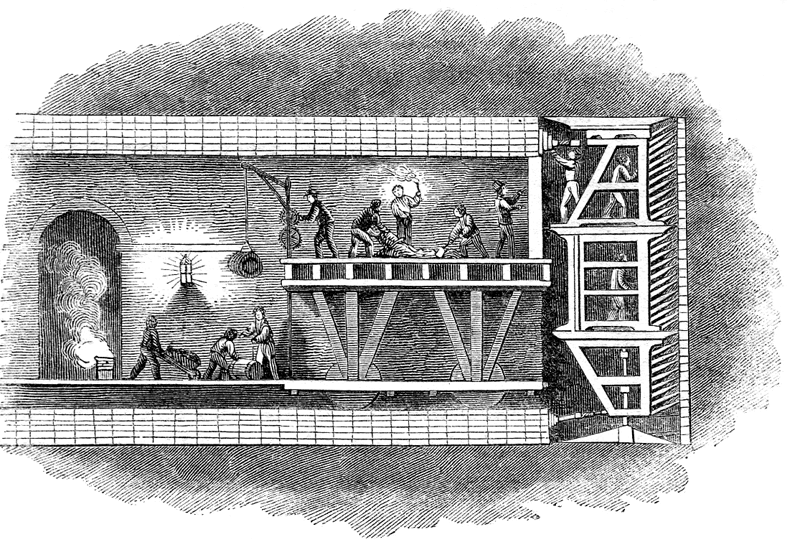
Brunel patented the shield in January 1818, jointly with the naval officer Thomas Cochrane, and had it built at Maudslay's works in Lambeth. Wikipedia describes twelve cast-iron frames side by side, each in three tiers, giving 36 cells with one miner in each, the whole frame roughly 22 feet high and 37 feet wide. Each of the twelve frames weighed over seven tons on Wikipedia's figure, and Smithsonian magazine puts the whole machine at about 90 tons, which is the same sum done two ways.
The face in front of each man was a wall of horizontal poling boards, screwed hard against the earth by jacks at either end. The miner took out one board, dug a few inches behind it (nine, on Smithsonian's account), put the board back and screwed it tight, then moved to the next. When every board in a frame had gone forward, the frame was jacked ahead to meet them, and the bricklayers behind lined the roof, walls and floor as the iron moved off them. The guidebook Brunel published while the works were open to visitors, which the University of Rochester holds, makes the point that no part of the excavation was ever left open.
It is a lovely piece of engineering logic and I don't think it gets nearly enough credit next to the bridges and viaducts of the period. Nobody designs a structural support system by copying a mollusc unless they have genuinely sat and watched the mollusc work.
The shield went to work between Rotherhithe and Wapping in 1825, and the Thames made its own position clear almost at once. The Brunel Museum says the tunnel advanced up to eight feet in a good 24 hours. Averaged across the whole job, Smithsonian puts it at about four inches a day. The men worked in air fouled by methane from the sewage-laden river water leaking into the workings, which TfL's own archive guide records, and Smithsonian lists the headaches, the temporary blindness and the sickness that went with it.
On 18 May 1827, with 549 feet dug, the river came in. Isambard Kingdom Brunel, who had taken over as resident engineer the year before at twenty when the original engineer fell ill, went down in a diving bell and plugged the hole in the riverbed with bags of clay. The second flood, on 12 January 1828, killed six men. Isambard was in the shield when it broke, a falling timber trapped his leg, and by most accounts a contractor named Beamish broke down a locked door and got him out. The SS Great Britain Trust, which holds his locked diary, quotes him from his sickbed as laid up and "quite useless" for fourteen weeks and more.
Money ran out not long after. The tunnel was bricked up behind the shield where it stood, in August 1828 on TfL's dating, and left for seven years. I find that detail harder to shake than the flood itself: a machine modelled on a creature that never stops digging, parked under the river and sealed up as if nothing had happened.
A Treasury loan of roughly £247,000 reopened the works in 1835, with a new and larger shield in place by 1836. More floods followed in 1837 and 1838, and the tunnel reached Wapping in 1841. It opened to pedestrians on 25 March 1843, at a penny a head, and had taken a million of them by July.
Wikipedia gives the cost as £454,000 to dig and another £180,000 to fit out, and TfL's guide gives £634,000 all in, which is the same figure. The original estimate, on one account, had been around £160,000. The spiral ramps that would have let carriages use it were never built, so a tunnel conceived for dock freight only ever took people on foot.
The same job, a few miles downstream
Silvertown is the first new road tunnel under the Thames in east London for a generation, 1.4 kilometres from Newham to the Greenwich Peninsula in two bores, and it was dug by one machine. She is called Jill, after Jill Viner, London's first female bus driver, and Herrenknecht built her in Germany. The numbers are a different species from Brunel's: 82 metres long, a cutting face a shade under 12 metres across (11.91 on TfL's figure, 11.87 on Herrenknecht's), the shield alone about 1,200 tonnes on Ferrovial's account and the whole train 1,800, though Herrenknecht's own data sheet says 2,300, and I suspect the difference is what you count as the machine. The largest diameter ever driven in Britain, both makers and client say, and nearly three double-decker buses wide.
What makes Jill a shield and not just a drill is what happens behind the cutting wheel. She is an earth pressure balance machine. The wheel loosens the ground into a sealed chamber behind it, and that chamber is kept full of a plastic soil paste, conditioned with foam or water, at a pressure matched to the earth and water pushing in from outside. Herrenknecht's own description is that balance is reached when the two pressures are equal, and the surface neither heaves nor settles. A screw conveyor at the bottom of the chamber takes the paste out, and its speed, set against the rate of advance, is the control.
Pressure sensors in the chamber wall tell the operators what the face is doing, which Brunel's miners learned from the water running past their boots.
The ground is what the mollusc would have recognised. Gall Zeidler, who designed the cross passages, describe an alignment through made ground, river alluvium, terrace gravels, London Clay, the Harwich Formation and the Lambeth Group, with the tunnels themselves sitting in water-saturated sediments under pressurised groundwater. The 2014 preliminary design, reported by TunnelTalk, put the tunnel invert only about 30 metres below ground at its deepest, and flagged the shallowness as the project's main risk, because it narrows the band of face pressures the machine can safely run at. Too little and the river comes in; too much and the riverbed lifts.
The lining goes in the way the shipworm's does, as part of the digging. Behind the chamber a vacuum erector lifts precast concrete segments into place, nine to a ring including the key, each just over eight tonnes, two metres wide and 400 millimetres thick, on figures from TfL's tunnelling manager Mark Thompson in Tunnels and Tunnelling and from Bekaert, who supplied the steel fibre that replaced the reinforcing cages in most of the rings. A ring weighs about 70 tonnes and the job needed 1,122 of them. Grout is pumped through the tail of the shield to fill the gap between ring and ground as the machine moves off. Jill then pushes herself forward off the ring she has just built, which is exactly what Brunel's jacks did off the brickwork.
Metres a day, not inches
Tunnelling started on 7 September 2022, with TfL expecting around ten metres a day. BAM Nuttall reported the first bore averaging about 18 metres a day and breaking through at Greenwich on 15 February 2023, after 1,106 metres. Then came the part that had never been done in Britain.
Rather than strip the machine and cart it back, Riverlinx turned her round inside a rotation chamber 40 metres long, the 1,450-tonne shield sitting on a sled over cushions of compressed nitrogen and swung through 180 degrees by chain hoists in a single day, which Herrenknecht and Construction Briefing both record. The return drive averaged around 22 metres a day under the river, on Riverlinx's figure, and Herrenknecht claims a best month of roughly 584 metres. The second breakthrough came on 23 July 2023. Both bores, inside eleven months.
I have not been able to find a published crew size for the machine itself, so I will not invent one. What TfL did publish, in September 2022, was around 780 people working full time across the project. The spoil, about 600,000 tonnes forecast and more than 780,000 tonnes moved by the time tunnelling finished, went out on conveyors to barges and down the river to a former landfill in Essex, which TfL says kept at least 18,000 lorries off the roads. The eight cross passages between the bores were dug with the ground frozen first, another first for the UK on Riverlinx's account.
Now the other column. TfL's construction figure is £1 billion, stated when Riverlinx was named preferred bidder in May 2019 and repeated since; Riverlinx raised £1.2 billion. City AM reported in September 2020, from TfL's own numbers, a 25-year payment stream of £1.6 billion before interest and close to £2 billion with it, against an original forecast of around £600 million that a London Assembly member called outrageous. The government delayed consent twice in 2017 over air quality, Friends of the Earth wanted it scrapped, and the local MP said it would make congestion worse. It opened on 7 April 2025, on the date announced, with a £1.50 off-peak charge on it and on Blackwall to pay the whole thing back.
Nothing in the public record I found mentions a death on the Silvertown job. That sentence would have been unthinkable at Rotherhithe, where the dead were part of the price and nobody tallied the cost of the sick.
Two shields
So set them side by side. Brunel's shield held the face with wooden boards and a man's forearms, 36 of them, and advanced nine inches at a time when the river allowed. Jill held hers with a chamber of her own spoil at a pressure the operators chose, and advanced two metres at a time, ring after ring: 22 metres in a day against Brunel's four inches on the average and eight feet on his best. Brunel's bricklayers built the lining course by course behind the iron. Jill's erector set nine pieces of precast concrete into a ring and grouted them before the ground knew the difference.
Both were jacked off what they had just built. Both were sealed up and left at some point, Brunel's for seven years behind a brick wall, Jill for a day on nitrogen cushions while she was turned round. Both cost three or four times what somebody first said they would, if the £160,000 and the £600 million are to be believed, and I would not put either figure on a final account without a caveat. One killed six men and sickened many more; the other was argued over for a decade in public before anyone was allowed to dig.
What I love is how little the idea has moved. Brunel looked at a pest and saw that the lining had to be part of the digging, and that the ground must never be left open. Two hundred years later the ground still is not left open; it is held in a steel chamber by the very earth that was just cut out of it, and lined within the hour. Jill, it is reported, has since been taken apart at Newham for her parts to go into another machine. The shipworm, lining its burrow as it goes, would have understood that too.
*Image: Diagram of Marc Brunel's tunnelling shield used to build the Thames Tunnel, anonymous, 19th century, public domain, via Wikimedia Commons.*
Comments